

Sustainability · 2025
In this section52 topics
- Sustainability Policy2 items
- Sustainability Goals & UN SDGs3 items
- Policy Review3 items
- Business Value Chain1 item
- Stakeholder Analysis2 items
- Environmental Policy & Guidelines3 items
- Environmental Policy Review3 items
- Energy — Plan & Guidelines2 items
- Energy — Electricity Consumption1 item
- Energy — Fuel Consumption3 items
- Energy — Targets2 items
- Energy — Performance & Outcomes2 items
- Water — Plan & Guidelines2 items
- Water — Withdrawal, Discharge & Consumption1 item
- Water — Targets2 items
- Water — Performance & Outcomes2 items
- Waste — Plan & Guidelines2 items
- Waste — Generation, Disposal & Recycling1 item
- Waste — Targets2 items
- Waste — Performance & Outcomes2 items
- GHG — Plan & Guidelines2 items
- GHG — Emissions1 item
- GHG — Emissions Verification3 items
- GHG — Principles & Standards1 item
- GHG — Targets1 item
- GHG Targets — Net Zero1 item
- GHG Targets — Other Targets1 item
- GHG — Performance & Outcomes2 items
- Environmental Legal Incidents1 item
- Other Environmental Management1 item
- Social Policy & Guidelines3 items
- Social Policy Review3 items
- Social — Principles & Standards Practised1 item
- Human Rights Due Diligence2 items
- Employees — Plan & Guidelines3 items
- Employees — Workforce1 item
- Employees — Remuneration & Provident Fund1 item
- Employees — Training & Development1 item
- Employees — Occupational Health & Safety1 item
- Employees — Labour Relations1 item
- Employees — Employee Representation1 item
- Employees — Targets2 items
- Employees — Performance & Outcomes2 items
- Customers — Plan & Guidelines3 items
- Customers — Satisfaction Results1 item
- Customers — Targets2 items
- Customers — Performance & Outcomes2 items
- Community & Social — Plan & Guidelines3 items
- Community & Social — Targets2 items
- Community & Social — Performance & Outcomes2 items
- Other Social Management1 item
- Law Violation Incidents1 item
Sustainability Policy
Has a Sustainability Policy
Yes
Policy Description
The Company operates under a sustainable development framework, adopting Environmental, Social, and Governance (ESG) principles as a corporate-wide management approach to drive quality growth, mitigate negative impacts, and enhance positive impacts for stakeholders across the value chain. Recognizing its role and responsibility to grow the business in parallel with sustainable development, the Company is committed to balancing business performance with social responsibility, environmental stewardship, and good corporate governance to promote the well-being of all stakeholder groups and support Thailand’s long-term economic development
As an importer and wholesaler, the Company is committed to conducting business responsibly and transparently in line with international standards. The Company adopts the SET Sustainability Reporting Guide as a key reference in shaping its sustainability strategy and policies. In this regard, the Company aligns its sustainability initiatives with the United Nations Sustainable Development Goals (UN SDGs) in areas where it can make a meaningful contribution, with particular emphasis on the following:
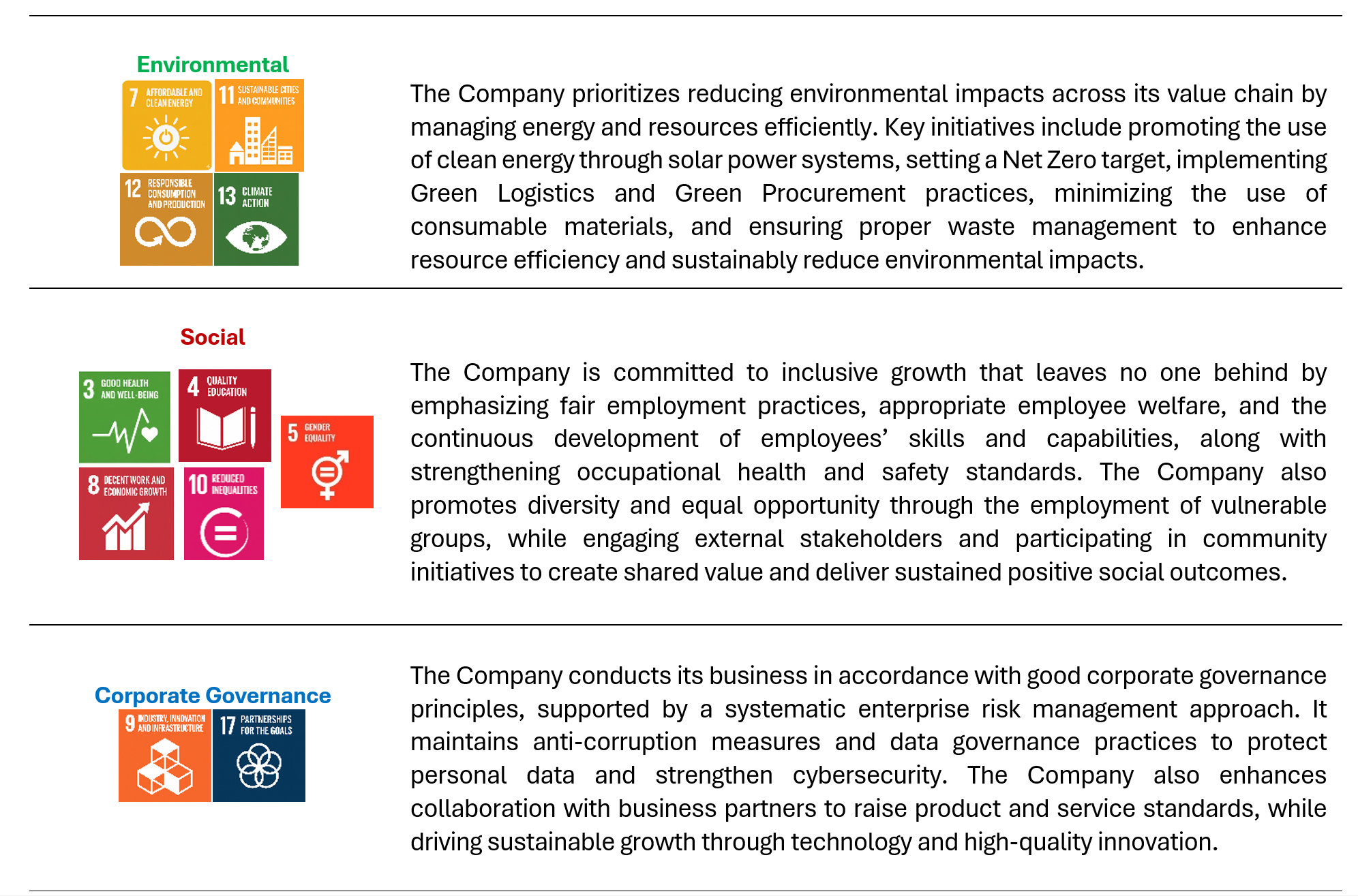
Sustainability Policy and Goal
The Company is dedicated to driving sustainable business operations by incorporating environmental, social, and governance considerations to address global challenges and create long-term value for all stakeholders. The Company believes that responsible business practices aligned with sustainability principles will enhance its competitiveness and ensure long-term growth and stability.
Additionally, the Company has expanded its business scope to focus on distributing environmentally friendly products, such as renewable energy solutions, to contribute to the efficient use of natural resources and promote clean energy adoption in the business sector and society.
The Sustainability Development team, led by the Managing Director and the Management, is responsible for proposing, developing, and reporting sustainability initiatives to the Corporate Governance and Sustainability Committee and the Board of Directors. The Committee’s work covers environmental, social, governance, and economic aspects, with clearly defined goals and key performance indicators aligned with the SET Sustainability Reporting Guide.
The Sustainability Development team reviews and refines sustainability strategies annually to align with evolving environmental and market conditions, ensuring maximum value for all stakeholders. Key focus areas include adoption of advanced technology and innovation, product and service responsibility, energy efficiency and renewable energy adoption, air pollution reduction, employee development and workplace safety, human rights compliance and community and social well-being initiatives.
Principles for Sustainability Operations
The Company establishes guidelines and best practices to promote sustainability across all business dimensions:
Corporate Governance and Business Ethics
Comply with applicable laws, regulations, and contractual obligations.
Operate with transparency, integrity, and zero tolerance for corruption.
Foster an ethical corporate culture and stakeholder engagement.
Environmental Management
Minimize environmental impact across importation, storage, and distribution processes.
Promote clean energy use, reduce GHG emissions, and implement efficient waste management.
Social and Labor Development
Uphold human rights, promote equality, and ensure fair employment opportunities.
Enhance employee health and safety while improving community well-being.
Support educational and technological skill development programs.
Technology and Innovation Strategy
Integrate cutting-edge technology for data and workflow optimization.
Reduce air pollution and energy consumption through technological advancements.
Select and offer products with innovative and safe technology to customers.
Transparent, Fair, and Reliable Management
Establish an effective corporate governance and reporting structure.
Uphold responsible business ethics for all stakeholders.
Implement risk management and governance monitoring mechanisms.
Employee Development Strategy
Promote human rights within the organization and uphold a fair workplace culture.
Continuously develop employees through comprehensive benefits and modern work tools.
Support career growth and competitive remuneration.
Sustainability Goals & UN SDGs
Has Sustainability Goals
Yes
Goals Description
Sustainability Goals
The Company is committed to responsible business operations and has set sustainability goals to create positive environmental, social, and governance impacts:
Environmental Goals
Reduce Scope 2 GHG emissions by 15% by 2027 (compared to the 2023 baseline) and achieve net-zero emissions by 2065.
Minimize waste generation by promoting recycling and circular economy practices.
Import and distribute energy-efficient and eco-friendly products to encourage sustainable resource use.
Social Goals
Maintain employment opportunities for persons with disabilities and underprivileged groups to promote workplace inclusivity.
Instill a sustainability mindset among employees through training and engagement activities that align with environmental and social objectives.
Governance Goals
Maintain active membership in the Thai CAC.
Ensure strict compliance with sustainability laws and regulations to uphold transparency and fairness in business operations.
UN Sustainable Development Goals
| SDG Goal |
|---|
| Goal 3 Good Health and Well-being |
| Goal 4 Quality Education |
| Goal 4 Quality Education |
| Goal 5 Gender Equality |
| Goal 5 Gender Equality |
| Goal 7 Affordable and Clean Energy |
| Goal 8 Decent Work and Economic Growth |
| Goal 8 Decent Work and Economic Growth |
| Goal 9 Industry, Innovation and Infrastructure |
| Goal 10 Reduce Inequalities |
| Goal 11 Sustainable Cities and Communities |
| Goal 12 Responsible Consumption and Production |
| Goal 13 Climate Action |
| Goal 13 Climate Action |
| Goal 17 Partnerships for the Goals |
Policy Review
Policy Reviewed This Year
Yes
Policy Changed This Year
Yes
Review Details
To adapt to global changes and create long-term value for all stakeholders, the Company has established an annual review and improvement process for its sustainability management policy and goals. This process is led by the Sustainability Development team under the supervision of the Corporate Governance and Sustainability Committee and the Board of Directors. The objective is to ensure that the Company’s business strategies remain aligned with current developments and international standards while driving sustainable value creation for all stakeholders. Through this ongoing review, the Company aims to foster long-term, stable growth and strengthen its commitment to sustainability.
In 2025, the Company’s sustainability policy updates aim to elevate its business approach to better address current global challenges. The focus is on creating a positive environmental impact, advancing social development, and ensuring transparent governance. This is achieved through clearly defined operational principles, concrete targets, and the integration of technology and innovation.
Business Value Chain
Value Chain Description
The Company operates a business specializing in importing and wholesale distribution of computers, software, peripherals, and office automation equipment in Thailand. Its business value chain encompasses end-to-end activities, from upstream to downstream, as outlined below:
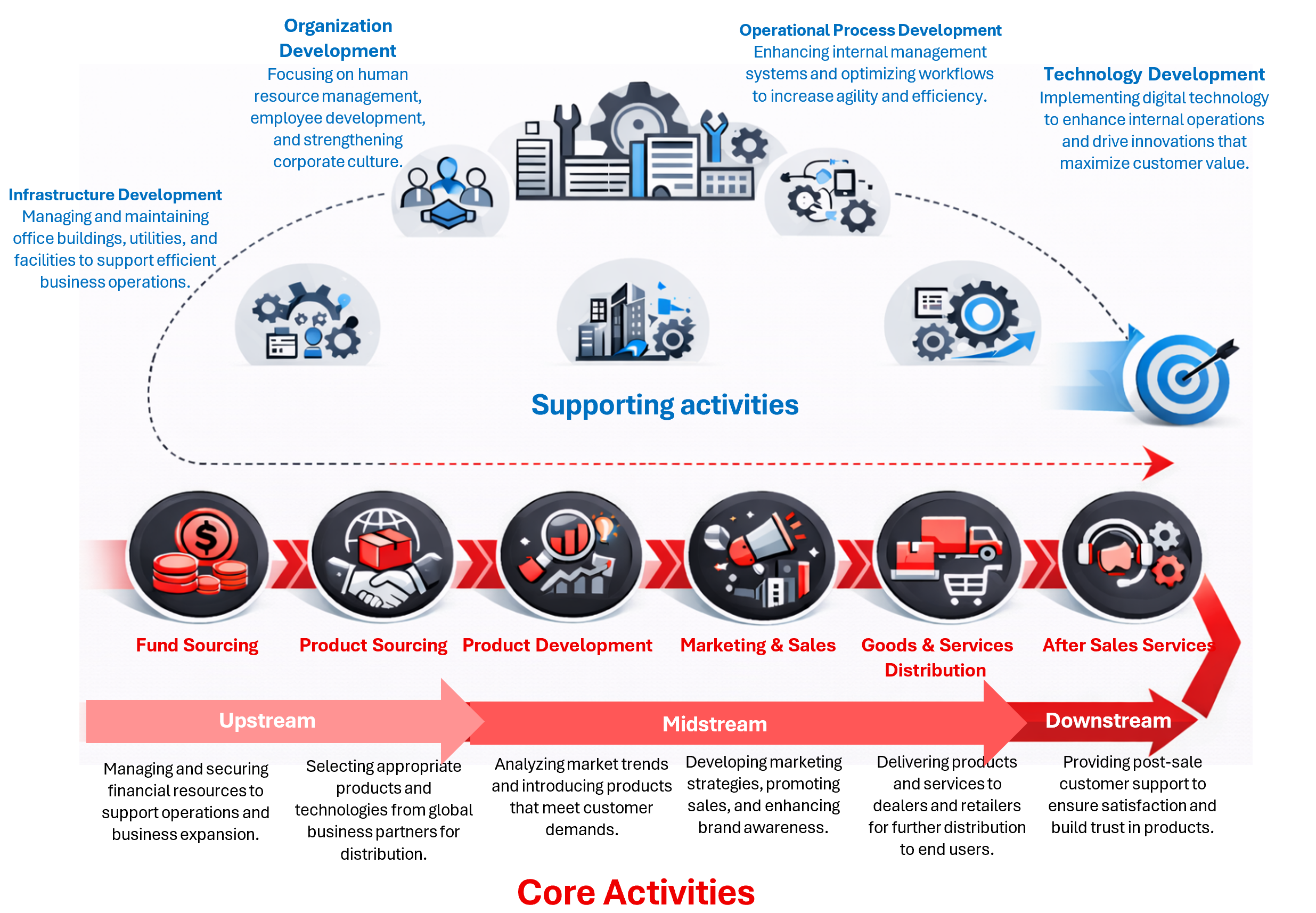
The Company has systematically categorized stakeholders across its business value chain, dividing them into internal stakeholders and external stakeholders.
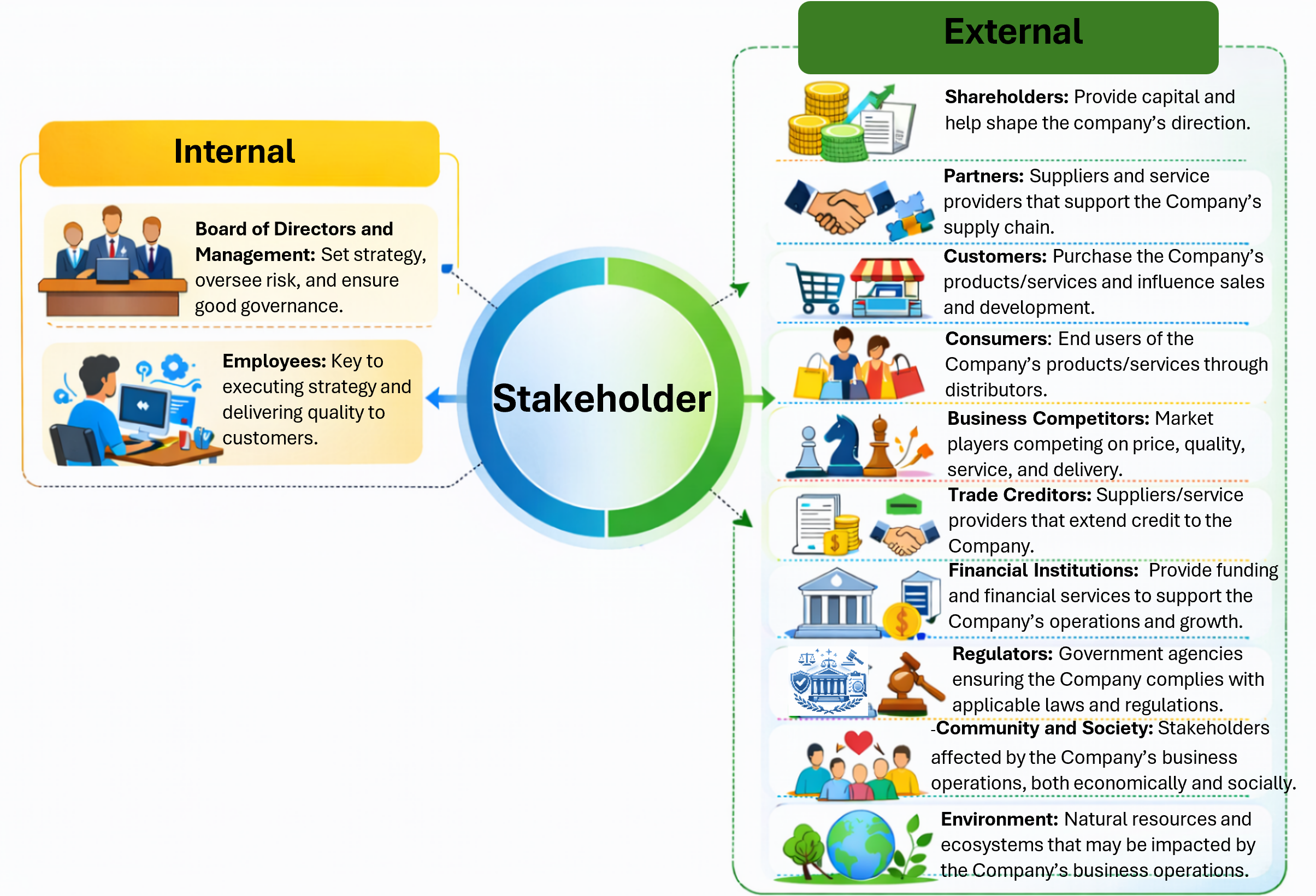
Stakeholder Analysis
Introduction
The Company conducts its business in accordance with good corporate governance and sustainability principles, with the objective of maximizing benefits and meeting the expectations of all stakeholder groups, as detailed below.
Stakeholder Analysis
| Stakeholder Type | Stakeholders | Stakeholder Expectations | Response to Expectations | Communication Activities |
|---|---|---|---|---|
| Internal stakeholders | 2897 · Description: Board of director · 2936 · Other name: Management · Description: Others | • Performance results in line with targets.
• Effective management of key risks.
• Strong corporate governance and internal controls.
• Timely information to support decision-making.
| • Execute the Company’s mission, vision, and strategy.
• Set clear and transparent business objectives grounded in good corporate governance.
• Allocate resources in alignment with the strategy and report results transparently.
• Regularly report performance results, including issues and risks, to the Board of Directors.
• Strictly enforce the Codes of Conduct and all related policies.
• Provide information to the Board of Directors in advance of meetings.
| 2942 · Description: Internal Meeting · 2949 · Other name: Board of Directors’ meetings. · Description: Others · 2949 · Other name: Internal approval system · Description: Others |
| Internal stakeholders | 2921 · Description: Employees | • Suitable compensation and benefits.
• A safe and healthy working environment.
• Opportunities for development and career advancement.
• Fair performance evaluation. | • Establish fair remuneration, including a comprehensive benefits program such as medical reimbursement, quarterly bonuses, annual bonuses, and the EJIP.
• Promote employee health, occupational health, and safety, e.g., annual health check-ups and installation of sterilization equipment.
• Provide clear career paths for employees, along with regular training to continuously enhance knowledge and skills.
• Create multiple communication channels to fully gather and address employees’ feedback and suggestions. | 2941 · Description: Online Communication · 2942 · Description: Internal Meeting · 2945 · Description: Complaint Reception · 2949 · Other name: Employee surveys. · Description: Others · 2949 · Other name: Suggestion submission system. · Description: Others |
| External stakeholders | 2913 · Description: Shareholders | • Return on investment.
• Strong performance and sustainable growth.
• Good corporate governance.
• Timely, clear, and transparent disclosure of information. | • Conduct business transparently and with strong corporate governance to achieve sustainable growth and continuously create value for shareholders and investors.
• Disclose information through the SET channels, the Company website, and the 56-1 One Report.
• Regularly engage with investors, including participating in SET Opportunity Day and providing quarterly performance briefings.
• Communicate through Investor Relations channels.
• Hold the Annual General Meeting of Shareholders each year. | 2941 · Description: Online Communication · 2944 · Description: Annual General Meeting (AGM) · 2949 · Other name: Form 56-1 One Report. · Description: Others · 2949 · Other name: Investor Relations Website. · Description: Others |
| External stakeholders | 2899 · Description: Suppliers | • Strong business partnership.
• Fair trade terms.
• Compliance with trade/commercial terms.
• Effective marketing.
• Sustainable growth.
| • Close communication to jointly plan commercial activities, maintain strong relationships, and stay updated on technology and customer care plans.
• Timely payment.
• Creating product value that is recognized and accepted by customers and consumers. | 2941 · Description: Online Communication · 2943 · Description: External Meeting · 2948 · Description: Training / Seminar · 2949 · Other name: Commercial contract · Description: Others · 2949 · Other name: Trade and technology exhibition. · Description: Others |
| External stakeholders | 2923 · Description: Customers | • High-quality products and services at competitive prices.
• Appropriate returns and strong business agility in operations.
• Continuous improvement and development of products and services.
• Excellent after-sales service.
| • Source products and services with appropriate profit margins.
• Facilitate product distribution.
• Provide credit facilities.
• Communicate through multiple channels supported by the Company.
• Marketing and sales promotion campaigns.
• Efficient, effective after-sales service.
| 2941 · Description: Online Communication · 2947 · Description: Satisfaction Survey · 2949 · Other name: Customer service centers · Description: Others · 2949 · Other name: Dedicated sales representatives responsible for each customer account. · Description: Others |
| External stakeholders | 2915 · Description: Consumers | • High-quality, safe products and services at reasonable prices.
• Strong after-sales service.
• Reliable warranty coverage. | • Provide high-quality, safe products and services at reasonable prices, including products that support and enhance convenience in daily life.
• Product usage instructions.
• Product warranties and after-sales service. | 2941 · Description: Online Communication · 2949 · Other name: Customer service centers · Description: Others |
| External stakeholders | 2898 · Description: Competitors | • Legally fair competition.
• No infringement of intellectual property rights.
• No use of improper or confidential information to undermine competitors.
• No unethical or inappropriate practices to attract customers. | • Immediately suspend or postpone any campaign or activity that may constitute a violation of competition laws.
• Immediately cease any conduct if intellectual property infringement or improper use of information to attack competitors is identified.
• Collaborate with competitors to support sustainable growth and development of the industry. | 2941 · Description: Online Communication |
| External stakeholders | 2936 · Other name: Trade Payables · Description: Others | • Timely payments.
• Compliance with mutually agreed terms and conditions.
• Close communication and regular discussions. | • Strict adherence to commercial terms and conditions.
• Close monitoring of operational procedures and execution steps. | 2941 · Description: Online Communication · 2949 · Other name: Commercial contract · Description: Others |
| External stakeholders | 2925 · Description: Financial institution | • Financial stability.
• Compliance with mutually agreed terms.
• Timely, clear, and transparent disclosure of information. | • Appropriate compliance with the terms and conditions of financial institutions.
• Regular communication through meetings, management discussions, and other channels.
• Effective cash flow management.
• Accurate financial reporting. | 2941 · Description: Online Communication · 2943 · Description: External Meeting · 2949 · Other name: Performance report. · Description: Others · 2949 · Other name: Financial institution system(s). · Description: Others |
| External stakeholders | 2931 · Description: Government agencies and Regulators | • Compliance with applicable laws and regulations. | • Conduct business in strict compliance with all applicable laws and government regulations, and ensure taxes are paid accurately and on a timely, regular basis.
• Continuously monitor and adapt to relevant changes in laws and regulatory requirements.
| 2941 · Description: Online Communication · 2948 · Description: Training / Seminar · 2949 · Other name: Reporting system(s) of the relevant authorities/agencies. · Description: Others |
| External stakeholders | 2902 · Description: Community · 2928 · Description: Society | • Operations that do not adversely impact quality of life.
• Contributing to community development and promoting educational and career opportunities.
| • Support social and community activities.
• Strictly comply with environmental and safety laws and regulations.
• Establish a grievance mechanism with prompt, transparent, and auditable complaint handling and issue resolution.
• Appropriately support local employment and procure goods and services from local suppliers.
| 2941 · Description: Online Communication · 2949 · Other name: The Company’s website · Description: Others |
| External stakeholders | 2936 · Other name: Environment · Description: Others | • Control and mitigate the environmental impacts of business operations.
• Promote clean energy and resource conservation. | • Strictly comply with all applicable environmental and safety laws and regulations.
• Install renewable energy systems (solar panels).
• Use technology to optimize route planning and reduce emissions.
• Deploy energy-efficient equipment and utilize alternative/renewable energy sources.
• Implement remote work arrangements for selected employees to help reduce air pollution.
• Conduct meetings, seminars, and product launches online to conserve resources. | 2941 · Description: Online Communication · 2949 · Other name: 56-1 One Report · Description: Others · 2949 · Other name: The Company's website · Description: Others |
Environmental Policy & Guidelines
Has an Environmental Policy
Yes
Policy Description
In an era where environmental considerations have become a crucial factor for sustainable business operations, the Company recognizes its responsibility to minimize environmental impact and promote the efficient use of resources. Accordingly, the Company has established comprehensive environmental policies and practices as guidelines for conducting business in a socially and environmentally responsible manner, as follows:
Environmental Guidelines
| Guideline |
|---|
| Electricity Management |
| Fuel Management |
| Renewable/Clean Energy Management |
| Water Management |
| Waste Management |
| Greenhouse Gas and Climate Change Management |
| Air Quality Management |
Environmental Policy Review
Policy Reviewed This Year
Yes
Review Details
The Company reviews its environmental policies, practices, and targets annually to ensure continued alignment with applicable laws, regulations, and relevant standards, and to refine them to reflect the business context, environmental conditions, and environmental management best practices. In doing so, the Company analyzes past performance, monitoring and evaluation data, and feedback from relevant stakeholders to support the setting and review of targets and action plans—advancing the achievement of sustainability goals and continuously reducing environmental impacts.
In 2025, the Company reviewed and updated its environmental targets in the following key areas:
Waste and Resource Management: The Company began more systematic data collection on the use of packaging and product box accessories that are recovered for further use and reuse. This enhances the completeness and reliability of data and supports the clear establishment of targets for diverting these waste streams, along with ongoing performance tracking against those targets.
Electricity Consumption and GHG Emissions: The Company revised its solar rooftop installation plan for its warehouse and completed additional installations at the Nakhon Ratchasima service center. As a result, the Company reviewed and adjusted its targets for reducing grid electricity consumption and GHG emissions to align with changes in the business plan and operational plan.
Fuel Energy Use:The Company improved its disclosures by separating fuel consumption by type: diesel and gasoline, to better reflect energy use in line with its operating profile. The Company also established clearer targets for fuel management to provide a framework for systematic monitoring and continuous improvement in energy efficiency.The Company improved its disclosures by separating fuel consumption by type: diesel and gasoline, to better reflect energy use in line with its operating profile. The Company also established clearer targets for fuel management to provide a framework for systematic monitoring and continuous improvement in energy efficiency.
Policies & Guidelines Changed
| Change |
|---|
| Electricity Management |
| Fuel Management |
| Renewable/Clean Energy Management |
| Water Management |
| Waste Management |
| Greenhouse Gas and Climate Change Management |
| Air Quality Management |
Energy — Plan & Guidelines
Has an Energy Management Plan
Yes
Plan Description
Energy Management
Promotes efficient energy use and reductilizes unnecessary energy consumption.
Implements energy-saving technologies such as LED lighting, motion sensor-based automatic lighting systems, and automated timers for electrical appliances.
Renewable Energy Management
Installs a solar PV power generation system at its warehouse and service center in Nakhon Ratchasima Province to reduce electricity expenses, with a long-term goal of expanding installations to generate sufficient electricity to cover the Company’s total power consumption, thereby enhancing energy cost stability in the future.
Imports and distributes products that improve energy efficiency and help reduce GHG emissions, such as solar power generation systems, solar-powered lighting, LED lighting, and electric vehicle (EV) chargers. This approach creates business opportunities in the growing clean energy market while strengthening the Company’s sustainability profile.
Provides solar PV installation services to customers under a Power Purchase Agreement (PPA) model, whereby the Company invests in and installs the system and sells the electricity generated to customers in accordance with contractual terms. This enables customers to avoid high upfront investment and reduce long-term electricity costs, while the Company earns recurring contractual revenue and contributes tangibly to GHG emissions reduction.
Energy — Electricity Consumption
Electricity Consumption
| Metric | Current Year | Previous Year | Two Years Ago |
|---|---|---|---|
| Total electricity consumption within the organization (Kilowatt-Hours) | 1,182,398 | 1,170,733 | 1,208,886 |
| Electricity purchased for consumption from non-renewable energy sources (Kilowatt-Hours) | 1,053,841 | 1,144,613 | 1,208,886 |
| Electricity purchased or generated for consumption from renewable energy sources (Kilowatt-Hours) | 128,557 | 26,120 | 0 |
Energy — Fuel Consumption
Introduction
Encourages the use of environmentally friendly vehicles, such as electric forklifts in warehouses.
Implements a work-from-home policy for certain employees to reduce commuting.
Leverages technology to minimize resource consumption, such as smart meeting room systems for virtual meetings and implement E-Billing for suppliers to submit invoices online rather than delivering physical documents.
Utilizes technology to support distribution planning and route optimization to improve efficiency, reduce travel distance and time, and thereby lower fuel consumption and GHG emissions.
Fuel Consumption
| Metric | Current Year | Previous Year | Two Years Ago |
|---|---|---|---|
| Crude oil (Barrels) | |||
| Coal (Metric tonnes) | |||
| Jet fuel (Litres) | |||
| Diesel (Litres) | 75,802 | 78,128 | 83,598 |
| Gasoline (Litres) | 4,649 | 5,549 | 6,027 |
| Fuel oil (Litres) | |||
| Natural gas (Standard cubic feet) | |||
| LPG (Kilograms) | |||
| Steam (Metric tonnes) |
Other Fuels
| Fuel | Unit | Current Year | Previous Year | Two Years Ago |
|---|---|---|---|---|
| Gasohol | 1673 · Description: Litres | 173,758 | 187,856 | 178,616 |
Energy — Targets
Has Set Targets
Yes
Targets
| Target | Base Year | Base Year Value | Target Year | Target Change (%) | Unit | Unit — Please Specify |
|---|---|---|---|---|---|---|
| Increase of electricity consumption from renewable energy sources | 2,025 | 10.87 | 2,026 | 2 | Others | Percent |
| Reduction of fuel consumption | 2,023 | 9.69 | 2,026 | 2 | Others | liters per million Baht of revenue |
Energy — Performance & Outcomes
Has Performance Results
Yes
Performance Description
Electricity
In 2025, the Company installed an additional solar power generation system at the Nakhon Ratchasima Service Center, following the installation at the warehouse in late 2024. As a result, the Company used a total of 128,557.40 kWh of electricity generated from solar energy out of total electricity consumption of 1,182,398.40 kWh, representing 10.87%.
This performance exceeded the Company’s target (≥10%) and demonstrates tangible progress in increasing the organization’s use of renewable energy.
Fuel
The Company has continuously reduced its fuel consumption intensity per total revenue from 9.69 liters/ million Baht in 2023 to 8.43 liters/ million Baht in 2025, representing a cumulative reduction of approximately 13%.
This performance exceeded the target (a reduction of ≥2% per year) and reflects the effectiveness of the Company’s energy and transportation management measures.
Water — Plan & Guidelines
Has a Water Management Plan
Yes
Plan Description
Promotes water conservation and efficient water use, and has established water-use control measures during holidays, such as inspecting and shutting off designated water valves, as well as regularly checking equipment and plumbing systems to ensure operational readiness, prevent disruptions, and reduce the risk of incidents such as burst water pipes.
Implements wastewater treatment measures and effluent quality controls in strict compliance with applicable laws and relevant environmental standards.
Water — Withdrawal, Discharge & Consumption
Water Withdrawal, Discharge & Consumption
| Metric | Current Year | Previous Year | Two Years Ago |
|---|---|---|---|
| Total water withdrawal (Cubic meters) | 5,222 | 5,522 | 5,673 |
| Total water withdrawal by third-party water (Cubic meters) | |||
| Total water withdrawal by surface water (Cubic meters) | |||
| Total water withdrawal by groundwater (Cubic meters) | |||
| Total water withdrawal by seawater (Cubic meters) | |||
| Total water withdrawal by produced water (Cubic meters) | |||
| Percentage of wastewater treated before discharge (%) | |||
| Total water discharge (Cubic meters) | |||
| Total water discharge to third-party water (Cubic meters) | |||
| Total water discharge to surface water (Cubic meters) | |||
| Total water discharge to groundwater (Cubic meters) | |||
| Total water discharge to seawater (Cubic meters) | |||
| Total water consumption (Cubic meters) | 5,222 | 5,522 | 5,673 |
| Recycled water (Cubic meters) |
Water — Targets
Has Set Targets
Yes
Targets
| Target | Base Year | Base Year Value | Target Year | Target Year Value | Target Change (%) | Unit | Unit — Please Specify |
|---|---|---|---|---|---|---|---|
| Reduction of water withdrawal | 2,023 | 7.12 | 2,026 | 7.12 | 0 | Other | liters per person |
Water — Performance & Outcomes
Has Performance Results
Yes
Performance Description
The Company has continuously reduced its water-use intensity from 7.12 liters per person in 2023 to 6.26 liters per person in 2025, representing a reduction of approximately 12%.
This performance met and exceeded the target, reflecting the effectiveness of the Company’s water resource management and its efforts to build internal awareness of water conservation.
Waste — Plan & Guidelines
Has a Waste Management Plan
Yes
Plan Description
Implements waste segregation at source in offices and warehouses, separating general waste, recyclable waste, and hazardous waste. Provide designated collection points for recyclables within operational areas to support material recovery, reduce the volume of waste requiring disposal, and improve sorting efficiency prior to recycling.
Manages electronic waste (e-waste) by handing it over to licensed disposal service providers in accordance with legal requirements and retains disposal certificates as evidence of proper treatment.
Promotes reuse and efficient resource utilization by donating items that remain in usable condition to relevant agencies or organizations in need and encouraging the reuse of packaging/boxes that are still in good condition to reduce waste and optimize resource use.
Applies resource-reduction practices, such as using electronic systems in place of paper, repurposing used paper for warehouse packing processes, and adopting business card formats that require fewer resources.
Promotes environmental knowledge and awareness among employees to reinforce discipline in waste segregation, waste reduction, and resource conservation across all departments.
Promote environmentally friendly practices by offering products and software solutions that help customers reduce paper use and resource consumption, thereby minimizing printing and overall resource utilization.
Waste — Generation, Disposal & Recycling
Waste Generation, Disposal & Recycling
| Metric |
|---|
| Total waste generated (Kilograms) |
| Non-hazardous waste (Kilograms) |
| Non-hazardous waste - Landfilling (Kilograms) |
| Non-hazardous waste - Incineration (with energy recovery) (Kilograms) |
| Non-hazardous waste - Incineration (without energy recovery) (Kilograms) |
| Non-hazardous waste - Other disposal operations (Kilograms) |
| Hazardous waste (Kilograms) |
| Hazardous waste - Landfilling (Kilograms) |
| Hazardous waste - Incineration (with energy recovery) (Kilograms) |
| Hazardous waste - Incineration (without energy recovery) (Kilograms) |
| Hazardous waste - Other disposal operations (Kilograms) |
| Total reused/recycled waste (Kilograms) |
| Reused/Recycled non-hazardous waste (Kilograms) |
| Reused non-hazardous waste (Kilograms) |
| Recycled non-hazardous waste (Kilograms) |
| Reused/Recycled hazardous waste (Kilograms) |
| Reused hazardous waste (Kilograms) |
| Recycled hazardous waste (Kilograms) |
Waste — Targets
Has Set Targets
Yes
Targets
| Waste Type | Disposal Approach | Target | Base Year | Base Year Value | Target Year | Target Year Value | Target Change (%) | Unit | Unit — Please Specify |
|---|---|---|---|---|---|---|---|---|---|
| Non-hazardous waste | 2763 · Other name: waste diversion for beneficial use · Description: Other | Increase waste utilization | 2,025 | 3.4 | 2,026 | 3.4 | 0 | Other | Kilograms per million Baht of revenue |
Waste — Performance & Outcomes
Has Performance Results
Yes
Performance Description
In 2025, the Company transferred non-hazardous waste for recovery or recycling at a rate of 3.4 Kilograms per million Baht of revenue. This serves as the base-year value for setting targets in subsequent years. The Company plans to continuously enhance the efficiency of waste segregation and waste recovery going forward.
GHG — Plan & Guidelines
Has a GHG Management Plan
Yes
Plan Description
Prepares GHG emissions reports for Scope 1 and Scope 2 to support analysis and effective management of emission sources.
Reduces GHG emissions by utilizing clean energy from solar PV systems, both through installations for the Company’s own operations and through PPA projects under which solar power generation systems are installed at customers’ premises and the electricity generated is sold to customers, thereby promoting clean energy adoption and contributing tangibly to GHG emissions reduction.
GHG — Emissions
GHG Emissions
| Metric | Current Year | Previous Year | Two Years Ago |
|---|---|---|---|
| Total GHG emissions (Metric tonnes of carbon dioxide equivalent) | 1,112 | 1,197 | 1,216 |
| Total greenhouse gas emissions 1 (Metric tonnes of carbon dioxide equivalent) | 580 | 623 | 611 |
| Total greenhouse gas emissions 2 (Metric tonnes of carbon dioxide equivalent) | 532 | 574 | 605 |
| Total greenhouse gas emissions 3 (Metric tonnes of carbon dioxide equivalent) |
GHG — Emissions Verification
Emissions Verified by a Third Party
Yes
Verifying Body
2652
Verification Document Link
https://eonemedia.setlink.set.or.th/report/0776/2025/1774062444972.pdf
GHG — Principles & Standards
Principles & Standards Applied
| Standard |
|---|
| 2671 |
GHG — Targets
Has Set GHG Targets
Yes
GHG Targets — Net Zero
Net Zero Targets
| Emission Scope | Base Year | Base Year Emissions | Near-term Target Year | Near-term Target Value | Near-term Target Change (%) | Long-term Target Year | Long-term Target Value | Long-term Target Change (%) | Target Year | Target Year Emissions | Target Change (%) | Unit |
|---|---|---|---|---|---|---|---|---|---|---|---|---|
| 2718 | 2,023 | 605 | 2,027 | 95 | 15 | 2,065 | 605 | 100 | 2,027 | 95 | 15 | Metric tonnes of carbon dioxide equivalent |
GHG Targets — Other Targets
Other GHG Targets
| Emission Scope | Base Year | Base Year Emissions | Near-term Target Year | Near-term Target Value | Near-term Target Change (%) | Long-term Target Year | Long-term Target Value | Long-term Target Change (%) | Target Year | Target Year Emissions | Target Change (%) | Unit |
|---|---|---|---|---|---|---|---|---|---|---|---|---|
| 2718 | 2,023 | 605 | 2,027 | 95 | 15 | 2,027 | 95 | 15 | 2,027 | 95 | 15 | Metric tonnes of carbon dioxide equivalent |
GHG — Performance & Outcomes
Has Performance Results
Yes
Performance Description
The Company has continuously reduced its Scope 2 GHG emissions from 605 tCO2e in 2023 to 532 tCO2e in 2025, representing a cumulative reduction of 12.07% This trend reflects the effectiveness of the Company’s energy management measures and the increased share of renewable energy use. Based on current performance, the Company is on track to achieve its 15% reduction target by 2027 as set out.
Environmental Legal Incidents
Legal Violation Incidents
| Metric | Current Year | Previous Year | Two Years Ago |
|---|---|---|---|
| Number of cases or incidents of legal violations or negative environmental impact (cases) | 0 | 0 | 0 |
Other Environmental Management
Plan Description
Air Quality Management
Implements a hybrid work policy for certain employees and deploy electric forklifts in warehouses to reduce emissions from internal combustion engines.
Ensures appropriate indoor air quality management, such as installing air purifiers in offices, maintaining Heating, Ventilation, and Air Conditioning (HVAC) systems, and replacing filters according to scheduled intervals, to support a safe and healthy working environment.
Support environmental quality improvement by offering relevant products and solutions, such as air purifiers, solar energy systems, and equipment for EV.
Green Procurement Process
Selects energy-efficient and environmentally friendly products and equipment, such as solar PV power generation systems, solar-powered lighting, LED lighting, and EV chargers, as well as Cloud products/services that enable digital data storage in place of consumable materials, and items made from recycled materials (e.g., recycled-fabric bags).
Establishes clear policies and assign dedicated personnel to study and monitor relevant technologies to support supplier and product selection, taking into account safety standards, product quality, the use of safe and environmentally friendly materials, and compliance with applicable laws and requirements.
Cooperates closely with suppliers and customers on environmental initiatives, including promoting the adoption of products that help reduce environmental impacts.
Safe and Environmentally Friendly Products
Selects and distributes safe products and solutions from reputable manufacturers and service providers, taking into account relevant certifications and standards applicable to each product category.
Designs and recommends solutions with security considered from the outset and with secure system configuration to reduce risks to users and data.
Promotes environmental sustainability by encouraging products that improve energy efficiency and help reduce GHG emissions, such as solar solutions.
Establishes appropriate guidelines for packaging, transportation, delivery, and installation to prevent damage and minimize safety risks during transit and installation.
Provides after-sales service and technical support, including safety guidance, system and software updates, and vulnerability management, to maintain safe and secure use on an ongoing basis.
Green Logistics
Utilizes the SkyFrog system to optimize transportation routes, reducing fuel consumption and carbon dioxide emissions.
Minimizes unnecessary packaging and prioritizes recyclable materials.
Partners with logistics service providers implement environmental measures, such as reducing paper usage in shipping documentation.
Environmental Awareness and Employee Engagement
Provides onboarding for all new employees through the Company’s e-Learning platform to ensure understanding of environmental practices and related policies and conducts annual refresher training via e-Learning.
The Company enrolls employees in the ESG DNA course through the SET’s platform; in 2025, employee participation reaches 96.21%.
The Company continuously fosters environmental awareness and promotes behaviors that reduce environmental impacts, such as using electronic documents and saving energy, and encourages employees to propose improvements to the Company’s environmental performance
Employees — Plan & Guidelines
Has an Employee Management Plan
Yes
Plan Description
Enhancing Employee Well-being
Provides fair remuneration and benefits in compliance with labor laws and competitive within the indus
try.Supports career development through continuous training and capacity building.
Maintains a safe work environment and promote employee health and well-being.
Promotes equal employment opportunities for underprivileged groups, such as senior citizens and persons with disabilities, in accordance with non-discrimination principles.
Prohibits child labor and forced labor, with internal monitoring measures in place.
Plan Areas
| Plan Area |
|---|
| Fair employee compensation |
| Employee training and development |
| Promoting employee relations and participation |
| Child labor |
| Occupational health and safety in workplace |
Employees — Workforce
Workforce Data
| Metric | Current Year | Previous Year | Two Years Ago |
|---|---|---|---|
| Total number of employees (Persons) | 834 | 801 | 797 |
| Number of male employees (Persons) | 404 | 365 | 366 |
| Number of female employees (Persons) | 430 | 436 | 431 |
| Total employment of disabled persons (people) | 1 | 1 | 1 |
| Total disabled employees (people) | 1 | 1 | 1 |
| Total male disabled employees (people) | 0 | 0 | 0 |
| Total female disabled employees (people) | 1 | 1 | 1 |
| Total disabled workers who are non-employee (people) | 0 | 0 | 0 |
| Contributions to the fund for promoting and improving the quality of life for disabled persons | 1 | 1 | 1 |
| Total number of male employees in operational level (Persons) | 345 | 308 | 313 |
| Total number of male employees in management level (Persons) | 49 | 47 | 43 |
| Total number of male employees in executive level (Persons) | 10 | 10 | 10 |
| Total number of female employees in operational level (Persons) | 394 | 398 | 395 |
| Total number of female employees in management level (Persons) | 33 | 35 | 33 |
| Total number of female employees in executive level (Persons) | 3 | 3 | 3 |
Employees — Remuneration & Provident Fund
Remuneration & Provident Fund
| Metric | Current Year | Previous Year | Two Years Ago |
|---|---|---|---|
| Total disabled employees (people) | 779,214,846.23 | 675,154,438.76 | 629,398,461 |
| Total male employee remuneration (Baht) | 421,962,774.28 | 355,124,463.09 | 333,227,715 |
| Total female employee remuneration (Baht) | 357,252,071.95 | 320,029,975.67 | 296,170,746 |
| Number of employees eligible to participate in PVD (persons) | 781 | 746 | 784 |
| Total number of employees joining employee provident fund (Persons) | 781 | 746 | 784 |
| Percentage of total number of employees joining employee provident fund to total number of employees (%) | 93.65 | 93.13 | 98.37 |
| Number of PVD members / Total eligible employees (%) | 100 | 100 | 100 |
| Total amount of provident fund contributed by the Company (Baht) | 17,113,855 | 14,870,810 | 14,651,682 |
| Total amount of provident fund contributed by employee (baht) |
Employees — Training & Development
Training Data
| Metric | Current Year | Previous Year | Two Years Ago |
|---|---|---|---|
| Average employee training hours (Hours / Person / Year) | 35.6 | 36.98 | 36.28 |
| Employee development and training expenses (baht) | 1,127,335.86 | 1,008,974.8 | 916,204 |
Employees — Occupational Health & Safety
Occupational Health & Safety Data
| Metric | Current Year | Previous Year | Two Years Ago |
|---|---|---|---|
| Total number of lost time injury incidents by employees (Cases) | 0 | 0 | 0 |
Employees — Labour Relations
Labour Relations Data
| Metric | Current Year | Previous Year | Two Years Ago |
|---|---|---|---|
| Total voluntary resignations (Persons) | 84 | 145 | 132 |
| Male employees who voluntary resigned (Persons) | 40 | 67 | 64 |
| Female employees who voluntary resigned (Persons) | 44 | 78 | 68 |
| Percentage of employee turnover leaving the Company voluntarily (%) | 10.07 | 18.1 | 16.48 |
| Evaluation result of employee engagement | 1 | 1 | 0 |
Employees — Employee Representation
Employees Are Represented Collectively
No
Employees — Targets
Has Set Employee Targets
Yes
Targets
| Indicator | Target Areas | Target Year | Target Year — Description |
|---|---|---|---|
| No complaints regarding unfair remuneration and discrimination. | 2983 · Description: Fair employee compensation | 2,025 | No complaints regarding unfair remuneration and discrimination. |
| No child labors. | 2987 · Description: Child labor | 2,025 | No child labors. |
| No fatal workplace accidents. | 2988 · Description: Safety and occupational health at work | 2,025 | No fatal workplace accidents. |
| Overall employee satisfaction | 2985 · Description: Promoting employee relations and participation | 2,026 | Overall employee satisfaction is over 85% |
Employees — Performance & Outcomes
Has Performance Results
Yes
Performance Description
The Company places great importance on fair and transparent labor management in alignment with international human rights principles. Key focus areas include respect for human rights, non-discrimination, safe working conditions, fair remuneration, and career development opportunities. These initiatives aim to enhance employee capabilities while ensuring long-term organizational stability. Additionally, the Company promotes employment opportunities for senior citizens, persons with disabilities, and outsourced workers to provide stable income and career growth. In 2025, the Company's key workforce initiatives included:
1) Fair and Equitable Employment and Remuneration
The Company remains committed to providing fair employment opportunities, promoting equality, and preventing discrimination by adhering to internationally recognized human rights and labor standards. As a result, there have been no reported incidents of human rights violations or unfair labor practices.
Furthermore, the Company upholds a strict anti-corruption policy by implementing transparent and ethical employment practices for government-affiliated personnel. These measures prevent conflicts of interest and maintain high ethical standards in business operations. In 2025, the Company’s employment statistics were as follows:
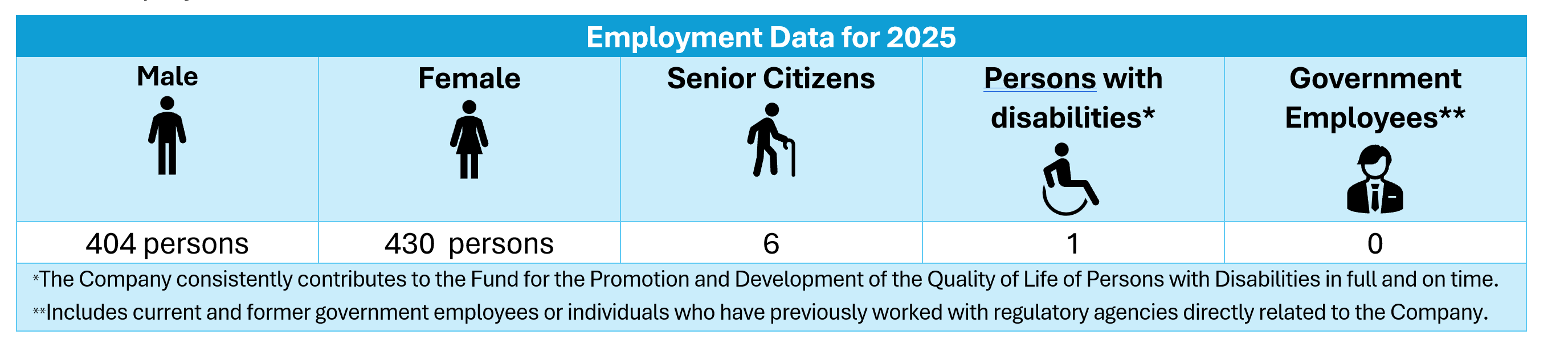
2) Employee Training and Development
The Company encourages employees to continuously enhance their knowledge, skills, and capabilities both within their respective fields and in additional competencies to improve work efficiency and maintain a positive attitude. Development is facilitated through self-learning, training programs, and seminars.
The Company provides training programs to enhance employees' skills and capabilities through both in-house training and external courses and seminars.
Sustainable Talent Seedling Program: The Company is committed to developing its people so they can realize their full potential and grow sustainably alongside the organization. Since 2016, the Company has selected internal employees to participate in the Sustainable Talent Seedling Program to strengthen their capabilities and prepare them for future leadership roles as the Company’s next generation of executives. The program includes training curricula designed to enhance knowledge and competencies across various areas. In 2025, the Company accepted a total of 7 interns who completed 4,536 training hours, providing them with opportunities to gain real-world work experience and apply this learning to further their studies. Over the years, the Company has nurtured many such seedlings, who will continue to grow and create value for themselves, the Company, and Thai society.
3) Workplace Safety, Occupational Health, and Work Environment
Annual Health Check-ups: The Company provides annual medical examinations for all employees, with screening programs tailored to their specific job roles to promote overall well-being.
Vaccination Support: The Company subsidizes 50% of the cost of influenza vaccinations and provides on-site vaccination services. In the event of other disease outbreaks, the Company has planned to collaborate with public health agencies to implement appropriate preventive measures.
Safe and Ergonomic Work Environment: Office and operational spaces are designed for safety and efficiency, with necessary equipment provided to support employee productivity.
Work from Home Policy: Due to increasing air pollution concerns, the Company has implemented a partial work-from-home policy and provides the necessary equipment for employees to work effectively.
Maternity Leave Policy: Employees are entitled to up to 120 days of maternity leave, with full salary paid for the first 60 days. The Company also strives to reintegrate returning employees into roles that match their expertise.
4) Promotion of Employee Relations and Engagement
Establish open internal communication channels to encourage employee feedback and suggestions, fostering a positive work environment.
Organize activities to strengthen employee relationships, such as annual corporate events connecting employees and the Management, team gatherings, and birthday celebrations with gifts for employees.
Implement the EJIP, where the Company matches the amount deducted from employees' salaries each month to purchase the Company’s common shares, with a matching contribution of up to 10% of the base salary.
Conduct surveys on employee turnover rates, organizational engagement, and employee satisfaction, using the findings to enhance employee relations and participation.
Customers — Plan & Guidelines
Has a Customer Management Plan
Yes
Plan Description
Customer Care and Consumer Responsibility
Selects high-quality, safe, and environmentally friendly products, while adopting new technologies to enhance customer convenience.
Develops an accessible after-sales service system and easy-to-use customer complaint channels.
Conducts regular customer satisfaction surveys to continuously improve products and services.
Prioritizes the protection of customers’ personal data.
Promotes consumer rights best practices and ensure transparency in the disclosure of product and service information.
Plan Areas
| Plan Area |
|---|
| Responsible production and services for customers |
| Communication of product and service impacts to customers/consumers |
| Development of customer satisfaction and customer relationship |
| Protection of customer personal information |
Customers — Satisfaction Results
Customer Satisfaction Results
| Metric | Current Year | Previous Year | Two Years Ago |
|---|---|---|---|
| Evaluation results of customer satisfaction | 1 | 1 | 1 |
Customers — Targets
Has Set Customer Targets
Yes
Targets
| Indicator | Target Areas | Target Year | Target Year — Description |
|---|---|---|---|
| Customer satisfaction | 3009 · Description: Development of customer satisfaction and customer relationship | 2,026 | 85% |
Customers — Performance & Outcomes
Has Performance Results
Yes
Performance Description
To enhance our understanding of customers, in 2025 the Company refined its customer satisfaction survey to better reflect the needs of each customer segment. The survey results showed an average satisfaction score of 88.63%, exceeding the target of 85%. Nevertheless, the Company continues to place strong emphasis on customer feedback and suggestions, using these insights to analyze, strengthen, and continuously improve sales and service processes across all dimensions—enhancing operational quality and supporting long-term sustainability.
Community & Social — Plan & Guidelines
Has a Community & Social Plan
Yes
Plan Description
The Company recognizes its role as an integral part of the communities and society in which it operates. It is therefore committed to creating shared value alongside responsible business practices, with emphasis on stakeholder engagement and community development in areas aligned with the Company’s business context and stakeholder expectations. These include promoting access to education and digital skills, creating equitable and inclusive employment opportunities, and enhancing safety and quality of life for relevant stakeholders.
The Company is committed to minimizing potential adverse impacts arising from its operations and to supporting resilient and sustainable community development. It focuses on implementing initiatives with measurable outcomes and that foster long-term community self-reliance. In 2025, the Company implemented the following key community and social initiatives:
1) Computers for Kids Program
This initiative supports educational opportunities and access to digital learning devices, helping reduce inequality in access to educational resources. The target beneficiaries are children and youth in Chiang Rai Province.
2025 implementation: The Company donated 20 laptop computers that had reached the end of their internal service life but remained in good working conditions to children and youth in Chiang Rai Province. The laptops are used for independent learning beyond the classroom, as well as for homework and assignments.
Implementation approach:
Identify target groups with a demonstrated need for learning devices and select recipient organizations with dedicated coordinators to ensure the equipment is used appropriately and on an ongoing basis.
Coordinate with recipient organizations to understand needs and intended use prior to handover.
Inspect and prepare the equipment to ensure it is fully operational before delivery to the representative responsible of the recipient organization.
Benefits:
Communities and society: Children and youth gain access to learning devices, increasing opportunities to develop digital skills.
The Company: Promotes optimal use of resources and demonstrates the Company’s commitment to social responsibility.
2) Jobs for All Program
This initiative promotes equal and non-discriminatory employment opportunities, supports access to work for groups that may face barriers to entering the labor market, and encourages the hiring of new graduates to strengthen early career opportunities. The target groups are new graduates, older persons, and persons with disabilities.
2025 implementation: The Company hired 23 new graduates, 6 older employees, and 1 employee with a disability to support employment and income opportunities for the target groups and to promote equality in hiring.
Implementation approach:
Assess the fit between job requirements and applicants’ qualifications to support appropriate and sustainable employment.
Conduct recruitment and selection based on capability and job fit, with due regard to equal opportunity.
Provide onboarding and role communication and ensure appropriate working conditions and equipment.
Monitor progress and employment suitability through performance management processes and communication with supervisors, using feedback for continuous improvement
Benefits:
Communities and society: Expands employment and income opportunities and supports greater equality in the labor market.
The Company: Strengthens workforce diversity and supports manpower continuity.
3) Sustainable Talent Pipeline Program
This program builds the capabilities of the Company’s workforce to enhance readiness and ensure manpower continuity. It focuses on developing high-potential employees for future leadership roles, while also providing hands-on learning opportunities for students to improve work readiness prior to entering the labor market and to build a long-term network of quality talent. The target groups are internal employees and interns.
2025 implementation: The Company continued to implement the Sustainable Talent Pipeline program to develop internal talent on an ongoing basis and to provide students with real-world work experience. In 2025, the Company accepted a total of 7 interns to strengthen their experience and readiness before entering the labur market.
Implementation approach:
Review qualifications, alignment with the relevant functional area, and learning and development objectives.
Define scope of work and internship hours and assign supervisors to provide guidance and monitor progress.
Evaluate internship performance and development against the defined framework or goals and collect feedback to improve program implementation in the following year.
Benefits:
Communities and society: Students gain practical work experience, improve career readiness, and develop skills aligned with labor market needs.
Employees: Participating employees receive opportunities to enhance knowledge, capabilities, and skills required for career advancement.
The Company: Supports long-term people development and workforce planning, strengthens manpower continuity and succession, and builds a future pipeline and network of quality talent.
4) Safe Workplace, Healthy Well-being Program
This program promotes safety, occupational health, and an appropriate working environment to safeguard employees’ health and quality of life, reduce the risk of work-related illness and accidents, and support business continuity. The target group is the Company’s employees.
2025 implementation: The Company provided annual health check-ups for all employees, as appropriate to job characteristics. It subsidized 50% of the cost of influenza vaccinations for employees and arranged for an on-site nurse to administer vaccines at the workplace. The Company also maintained and improved the work environment to ensure it is safe and suitable. To protect employees from air pollution, certain employees were permitted to work from home, with necessary work equipment provided. In addition, the Company implemented statutory maternity leave and supported employees in returning to their former positions or other suitable roles.
Implementation approach:
Implement safety and occupational health measures appropriate to each job function and communicate related practices comprehensively to employees.
Allocate necessary resources to support employee health and safety.
Monitor effectiveness through the collection of data and feedback via electronic systems and continuously improve measures accordingly.
Benefits:
Communities and society: Supports workforce health and safety, helping promote quality of life and reduce health risks that may affect employees’ families and surrounding communities.
Employees: Improves health and safety, reduces risks of work-related illness and accidents, and increases confidence at work.
The Company: Reduces occupational health and safety risks, supports business continuity, and strengthens employee engagement with the organization.
5) Safe Drive, Confidence on Every Routes Program
Given the Company’s business nature, primarily importing and distributing products, transportation and distribution are core operational processes. The Company therefore implements this program to enhance safety and reduce concerns regarding accident risks associated with vehicles used for product transportation. The program aims to support the quality of life and peace of mind of personnel involved in transportation. The target scope covers drivers and vehicles used in the Company’s transportation and distribution activities.
2025 implementation: The Company arranged accident insurance policies covering risks for vehicles used to transport goods to strengthen risk management and provide greater assurance to relevant personnel. The Company has continued this program for the 10th consecutive year. In 2025, 13 transport vehicles participated in the program, representing 100% coverage.
Implementation approach:
Assess vehicle usage types and transportation-related risks to determine appropriate insurance coverage.
Coordinate with external logistics/service providers to ensure safety and risk management practices are implemented in line with the Company’s guidelines.
Maintain policy documentation and related evidence and periodically review the adequacy of coverage according to the defined schedule.
Benefits:
Communities and society: Enhances transportation-related safety and reduces risks and impacts from road accidents.
Transportation personnel: Provides greater peace of mind and protection against accident risks that may occur during operations.
The Company: Strengthens transportation risk management, supports business continuity, and elevates safety standards across the distribution process.
Plan Areas
| Plan Area |
|---|
| Employment and professional skill development |
| Occupational health, safety, health, and quality of life |
| Disadvantaged and vulnerable groups |
| Water and sanitation management |
| Reducing inequality and promoting social equality |
Community & Social — Targets
Has Set Community & Social Targets
Yes
Targets
| Indicator | Target Areas | Target Year | Target Year — Description |
|---|---|---|---|
| No fatal workplace accidents. | 3041 · Description: Occupational health, safety, health, and quality of life | 2,025 | No fatal workplace accidents. |
Community & Social — Performance & Outcomes
Has Performance Results
Yes
Performance Description
1) Computers for Kids Program
2) Jobs for All Program
3) Sustainable Talent Pipeline Program
4) Safe Workplace, Healthy Well-being Program
5) Safe Drive, Confidence on Every Routes Program
Other Social Management
Plan & Outcomes — Description
Sustainable Collaboration with Business Partners
Conducts business with partners on the basis of fairness and transparency, without taking unfair advantage.
Promotes fair labor standards and respect human rights throughout the supply chain.
Encourages business partners to comply with ethical guidelines and fair labor practices.
Collaborates with partners to meet a range of commercial terms and requirements.
Focuses on sustainable shared growth through continuous development of knowledge and capabilities.
Promotes local employment to help distribute income to communities.
Supports social and community initiatives, such as education, public health, and environmental projects.
Law Violation Incidents
Law Violation Incidents
| Metric | Current Year | Previous Year | Two Years Ago |
|---|---|---|---|
| The total number of cases or incidents of significant violations of laws or regulations regarding social and human rights (Cases) | 0 | 0 | 0 |
| The total number of cases or incidents that cause significant labor disputes (Cases) | 0 | 0 | 0 |
| The total number of cases or complaints related to consumer rights violations (Cases) | 0 | 0 | 0 |
| The total number of cases or complaints related to partner rights violations (Cases) | 0 | 0 | 0 |
| The total number of cases or incidents that cause disputes with the community/society (Cases) | 0 | 0 | 0 |
| The total number of cases or incidents related to cyber security or customer data breaches (Cases) | 0 | 0 | 0 |
| The total number of cases or incidents related to safety and occupational health at work (Cases) | 0 | 0 | 0 |