SIS DISTRIBUTION (THAILAND) PUBLIC COMPANY LIMITEDSET: SIS🇹🇭 TH

CG Policy · 2025

Corporate Governance Policy

Has a Corporate Governance Policy

Yes

Policy Description

The Corporate Governance and Sustainability Committee emphasizes the importance and commitment to conducting business in accordance with principles of good corporate governance and Codes of Conduct, as outlined in the established framework and policies. This ensures that the Company's corporate governance activities are efficient and effective, instilling confidence in shareholders and stakeholders alike. The Company is dedicated to aligning the Company's operations with corporate social responsibility and environmental sustainability under ethical guidelines. The Company endorses good corporate governance practices by refraining from supporting activities that infringe intellectual property rights and ensuring robust management systems to prevent fraud and corruption. Additionally, the Company integrates the principles of sufficiency economy to drive sustainable business success. It is endeavor to promote a culture where all employees consistently adhere to principles of good corporate governance, thereby ensuring the Company's sustainably success.


Overview of Corporate Governance Policy and Guidelines
“Corporate governance” refers to the governance relationships, including the mechanisms and measures used to ensure that decision-making within the organization aligns with its objectives. This includes setting the company’s objectives, key goals, strategies, and policies; reviewing and approving business plans and budgets; and monitoring, evaluating, and overseeing performance reporting.

The Company recognizes the importance of good corporate governance and has therefore established an effective governance structure, mechanisms, and systems covering oversight, monitoring, and performance evaluation. The Company adheres to and complies with the Principles of Good Corporate Governance for Listed Companies (CG Code) issued by the Securities and Exchange Commission (SEC) and the SET as its primary operating guideline, and implements practices, as appropriate, in line with the OECD’s internationally recognized corporate governance standards.

In this regard, the Company upholds five fundamental principles of good corporate governance, as follows:

  • Integrity: Manages the operations with honesty, integrity, trustworthiness, and adherence to correctness.

  • Fairness: Actions towards stakeholders of the organization are conducted equitably and justly.

  • Transparency: Conducts the operations with clear and open disclosure of information to relevant stakeholders, allowing for scrutiny and verification.

  • Responsibility: Fulfill duties and responsibilities with intelligence and full capability, aiming for successful outcomes and continuous improvement.

  • Accountability: Accepting and taking responsibility for the consequences of actions, orders, assignments, and decisions based on their roles and responsibilities. This includes the ability to explain and justify decisions made.

In addition, the Company also adopts guidelines from the ASEAN CG Scorecard and criteria from the Thai Listed Company Corporate Governance Survey by the Thai IOD. These policies and guidelines are established by the Corporate Governance and Sustainability Committee and are presented to the Board of Directors for consideration on a yearly basis.

Policy & Practices — Board of Directors

Has Policy & Guidelines for the Board

Yes

Board Guidelines

GuidelineOther — Please SpecifyDetail
Nomination of Directors

The Company has established a systematic and transparent policy for the nomination and appointment of directors, as set out in the Charter of the Board of Director and reviewed periodically to ensure alignment with good corporate governance principles. The nomination of new directors includes disclosure of the following key matters:

1) Sources for Director Candidates
When a director position becomes vacant, the Company Secretary will search for and consider suitable candidates from the Thai IOD director database (Thai IOD Director Pool) for further consideration under the Company’s process. For director positions representing a major shareholder, the Company may also consider candidates nominated by the major shareholder, provided that such candidates meet the Company’s prescribed qualifications, pass suitability assessment, and undergo conflict-of-interest screening in accordance with the Company’s procedures.

2) Criteria for Nomination of New Directors
The Company clearly defines director qualifications and considers them in line with the Board’s needs from time to time, taking into account:

  • The nominee’s qualifications and suitability in accordance with the Company’s requirements;

  • Diversity of the Board structure (e.g., expertise, experience, gender, and other relevant factors);

  • Suitability for the Company’s business and strategic direction (e.g., business nature, future plans, organizational size, and current Board composition); and

  • Conflict-of-interest review prior to submitting a nomination for consideration.

(3) Process for Nomination of New Directors

  • When a vacancy arises, the Company Secretary prepares a list of qualified candidates from the sources above and conducts a preliminary review of qualifications, suitability, and potential conflicts of interest.

  • The Company Secretary submits the list to the Remuneration and Nomination Committee, which is responsible for sourcing, selecting, and screening candidates, considering the director database, candidates’ experience, suitability for the business, future plans, organizational size, and current Board composition.

  • The Remuneration and Nomination Committee then provides its recommendation to the Board of Directors for approval. If more than one suitable candidate is available, the Board of Directors will consider and elect candidates on an individual basis.

  • In the case of directors due for re-election at the end of their term, once endorsed by the Board, the names will be proposed to the shareholders’ meeting for approval by a majority vote. In the event of a tie, the Chairman of the meeting shall have the casting vote.

  • In the case of a vacancy arising for reasons other than term expiration, the Remuneration and Nomination Committee will screen and propose a candidate for appointment by the Board at the next meeting (unless the remaining term is less than two months). The appointment resolution must be approved by no less than three-quarters of the remaining directors, and the appointed director shall hold office for the remaining term of the director being replaced.

Determination of Director Remuneration

1) Monetary Remuneration

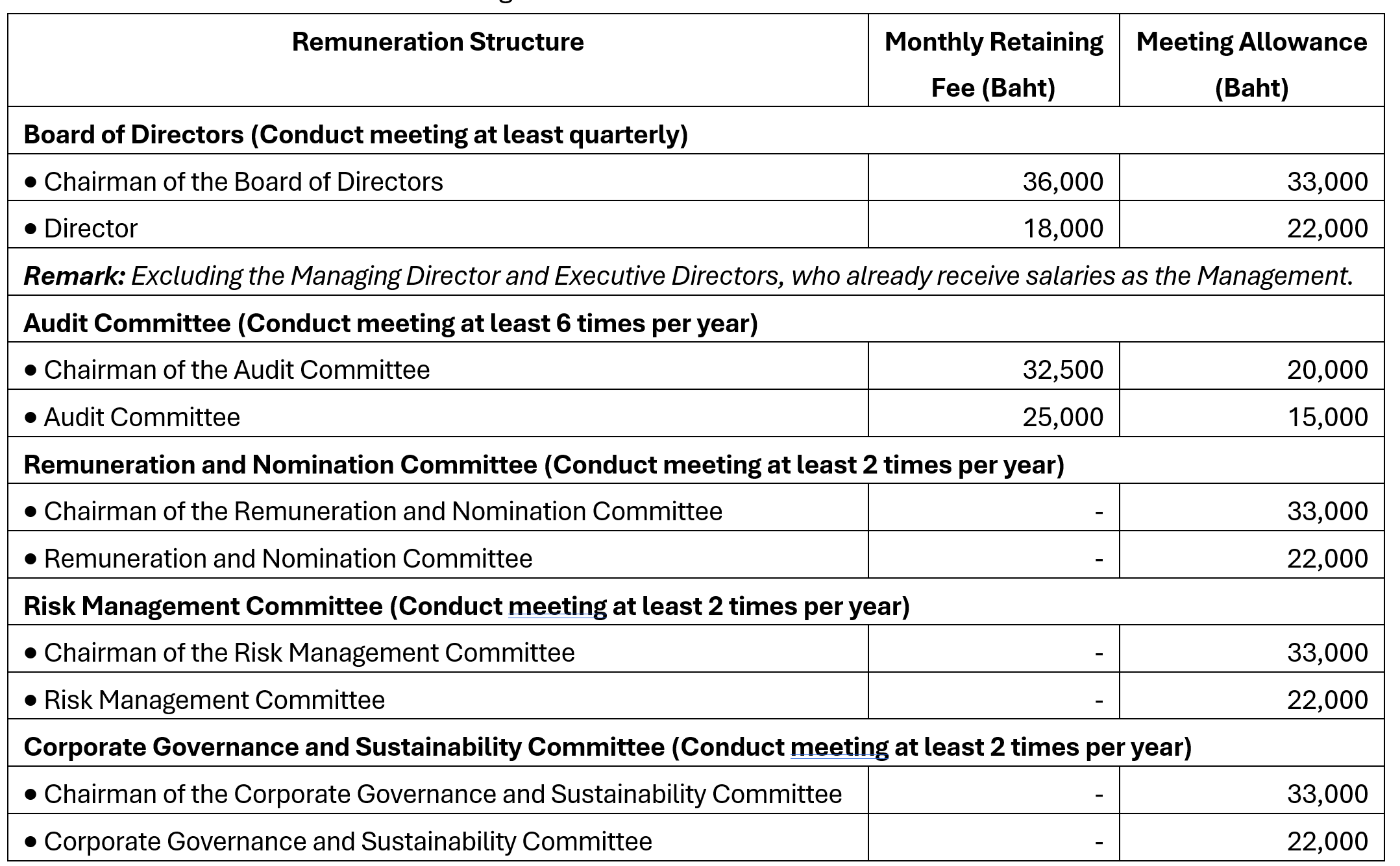
The Remuneration and Nomination Committee is responsible for reviewing and proposing director remuneration, taking into account their responsibilities, workload, and an appropriate remuneration structure aligned with industry standards. Director remuneration is categorized as follows:

Additionally, the Company considers the following:

Annual Special Reward: Paid once a year based on performance, as determined by the Remuneration and Nomination Committee in accordance with established criteria. This reward is granted to all directors, except executive directors and non-executive directors.

EJIP Stock Purchase Contribution: Provided to executive directors under the approved conditions applicable to the Management.

2) Other Remuneration
None.

Independence of the Board of Directors from the Management

The Company places great importance on the independence of the Board of Directors to ensure transparent and effective corporate governance. The board's composition adheres to the guidelines set by the SEC, requiring that at least one-third of the total board members, and no fewer than 3, be independent directors. Additionally, the Audit Committee must have at least 3 members.

To maintain a balance of power, the Company has separated the roles of Chairman and the Managing Director:

  • The Chairman of the Board of Directors: responsible for setting strategic direction, overseeing board meetings, and promoting active participation among board members.

  • The Managing Director: Leads the Management and is responsible for executing business operations in line with the board-approved policies.

The Board of Directors collectively participates in policy-making, budgeting, and operational planning. To uphold neutrality and transparency, directors with conflicts of interest in specific matters must abstain from voting on related issues.

The Company has established clear distinctions between the roles of the Board of Directors and the Management. The Board of Directors is responsible for corporate governance, policy formulation, and strategic planning, while the Management ensures operational execution, investment oversight, and business administration in alignment with these policies.

Furthermore, the Company facilitates ongoing communication of strategies, objectives, performance, and operational direction to the Management and employees through monthly meetings. It also has a leadership development and succession plan for the Management and senior Management to ensure seamless management continuity in the event of key leadership changes.

Director Development

The Company is committed to promoting and supporting the continuous development of its directors to ensure they perform their duties effectively. This includes training programs from reputable institutions such as the Thai IOD, the SET, the Federation of Accounting Professions under the Royal Patronage (FAP), and other relevant courses aligned with good corporate governance principles.
The Company has established director development as a key principle of corporate governance, encouraging and facilitating regular training from relevant regulatory bodies and other organizations. This is supported and coordinated by the Company Secretary.
The Company provides an orientation program led by the Managing Director for every newly appointed director to ensure a solid understanding of the industry and the Company’s operations. The program also covers the nature of the business and key operational strategies. In 2025, no new directors were appointed.

Board Performance Evaluation

To enable the Board of Directors to review and assess its own performance, the Company’s Board and its sub-committees conduct annual performance evaluations. In 2025, the Company adopted the Thai IOD’s Board Self Check assessment as a guideline to further enhance and improve their effectiveness. The evaluation covers key dimensions, including structure and qualifications; roles, duties, and responsibilities; meeting effectiveness; stakeholder engagement; training and required resources; and reporting. The assessment is conducted at three levels, as follows:

  • The Board of Directors.

  • Sub-committees.

  • Individual directors.

The Company Secretary coordinates and consolidates the evaluation results from the Thai IOD before forwarding them to the Secretary to the Remuneration and Nomination Committee for submission to the Committee to consider and determine guidelines for enhancing the Board’s effectiveness. Thereafter, the Company Secretary processes and records the information and makes the relevant disclosures in accordance with the prescribed procedures.

Corporate Governance of Subsidiaries and Associated Companies

The Company has established a governance policy for its subsidiaries and affiliates to ensure that their operations are conducted efficiently, transparently, and in alignment with good corporate governance principles. The key governance practices are as follows:

1) Appointment of Directors and Management

  • The Board of Directors has the authority to appoint directors, the Management, or other key positions in subsidiaries. Currently, 4 members of the Board of Directors have been appointed as directors in the subsidiaries to oversee operations, make decisions in the best interests of the subsidiaries, and ensure alignment with the policies and strategies of the parent company.

  • The appointment and removal of directors or senior Management in subsidiaries must be approved by the Board of Directors and comply with the established criteria.

2) Internal Control Oversight

  • The Board of Directors ensures that subsidiaries implement appropriate internal control systems that align with applicable standards, laws, and regulations.

  • Regular internal audits are required to ensure operational efficiency and compliance with the Company's policies.

3) Disclosure and Key Transactions

  • Subsidiaries must comply with the disclosure requirements set by the SET and the SEC, particularly regarding related-party transactions, asset acquisitions and disposals, or other material transactions.

  • Subsidiaries must maintain an auditable accounting system that allows for timely consolidation of financial statements with the parent company.

Since the Company's affiliates has ceased operations and is under consideration for liquidation, the Company has not appointed additional board members for oversight. In 2025, the governance of subsidiaries and associates has been carried out in accordance with the established policies and practices.

Other guidelines regarding the board of directorsQualification of the Directors

The Company has defined the qualifications of its directors in the Board of Directors’ Charter, which is regularly reviewed. The qualifications are as follows:

  • Be qualified according to the Public Limited Companies Act, the Securities and Exchange Act, and the Company’s Articles of Association without any prohibited characteristics outlined in the announcement from the SEC regarding the qualifications of listed company management.

  • Exhibits leadership qualities characterized by a broad vision and a profound understanding of the Company’s business operations.

  • Capable for executing tasks independently, expressing opinions freely and can allocate sufficient time for task execution.

  • Holds the position of director in listed companies, with a maximum limit of 5 companies.

Other guidelines regarding the board of directorsCharter of the Board of Directors and its Sub-Committees

The Board of Directors represents shareholders in driving the organization forward, playing a key role in setting strategies, policies, and overseeing business operations with responsibility, transparency, and fairness to all stakeholders. This is conducted in accordance with good corporate governance principles to maximize the benefits for the Company and its shareholders while promoting sustainable growth alongside society.

To ensure proper governance, the Company has established the Charter of the Board of Directors and its subcommittee as guidelines for directors to perform their duties effectively. These charters are reviewed regularly and published on the Company’s website, as well as in Attachment no.10, covering key topics, including:

  • Scope of Responsibilities.

  • Roles of the Chairman of the Board of Directors.

  • Composition of the committees.

  • Director’s qualification.

  • Terms of Office for the Board of Directors.

  • Director Nomination and Appointment.

  • Meeting and Quorum.

  • Authority of Approval.

  • Remuneration.

Other guidelines regarding the board of directorsRoles of the Chairman of the Bord of Directors

The Chairman of the Board of Directors, as the individual responsible for setting the strategic direction, with approval from the Board of Directors, has the following roles and responsibilities:

  • Considers setting the agenda for Board of Directors’ meetings in collaboration with the Management Director, and ensure that directors receive accurate, comprehensive, clear, and timely information before the meetings to support the directors for appropriate decision making.

  • Serves as the leader of the Board of Directors and be the Chairman for the Board of Directors’ meetings.

    • Conducts the Board of Directors’ meetings in accordance with the agenda, the Company's Articles of Association, and legal requirements.

    • Allocates sufficient time and encourages all directors to express their opinions freely, fosters independent thinking and exercises sound judgment, taking into consideration the interests of all stakeholders comprehensively.

    • Summarizes the resolutions made during the meeting and clearly defines the actions to be taken next.

    • Organizes the Board of Directors’ meeting without the presence of the executive director (Non-Executive Directors’ meeting).

  • Leads the shareholders’ meeting in accordance with the agenda, the Company's Articles of Association, and legal requirements. Allocates appropriate time, provide equal opportunities for shareholders to express their views, and ensures that questions from shareholders are addressed appropriately and transparently.

  • Supports and serves as a good example in adhering to corporate governance principles and the Company Codes of Conduct, including sustainability principles.

  • Fosters good relationships between the Board of Directors and the Management, including supports the execution of duties by the Management Director and the Management according to the Company's policies.

  • Ensures transparency in disclosing information and managing conflicts of interest when conflicts arise.

  • Supervises to ensure that the appropriateness of the Board of Directors structure and composition.

  • Supervises to ensure the effective and efficient performance of the Bord of Directors, its sub-committees, and each director.

  • Supervises the performance assessment of the Board of Directors, its sub-committees, individual director, and the Managing Director. Uses the assessment results to enhance performance, drive continuous improvement, and foster knowledge and skill development among the Board of Directors and its sub-committees.

Other guidelines regarding the board of directorsRoles of the Managing Director

As the leader of the Management, the Managing Director is responsible for overseeing the Company's operations in alignment with the policies approved by the Board of Directors. The key responsibilities include:

  • Exercising authority to manage and operate the Company within the policies assigned by the Board of Directors, ensuring compliance with applicable laws, regulations, corporate bylaws, and corporate governance standards.

  • Supervising and managing the Company’s business operations in accordance with the Board-approved direction and corporate governance principles.

  • Reviewing and proposing improvements to operational procedures to ensure relevance, modernization, and compliance with regulatory requirements before submission to the Board of Directors for approval.

  • Consider and approve the execution of normal business transactions under general commercial terms, within the approved budget set by the Board of Directors or in accordance with the principles approved by the Board of Directors. Such transactions must comply with the regulations of the SEC and the SET regarding connected transactions and the acquisition or disposal of assets.

  • Performing other duties as assigned by the Board of Directors within the approved scope of authority.

    Limitations of the Managing Director’s Authority

  • The delegation of authority to the Managing Director, including the further delegation of authority to any person deemed appropriate by the Managing Director, must not result in the authorization of transactions in which the Managing Director or any related party may have a conflict of interest or any potential conflict with the interests of the Company or its subsidiaries.

  • Transactions involving related parties must adhere to the Company’s standard commercial terms and remain within the framework set by the Board of Directors.

  • Transactions involving significant assets must comply with the regulations of the SET and the requirements of the SEC.

  • Transactions requiring Board or shareholder approval must be submitted for review and approval by the relevant governing body in accordance with established procedures.

Other guidelines regarding the board of directorsBoard of Directors' Authority of Approval

The Board of Directors has the authority to approve various company matters within the scope of its responsibilities as defined by law, the Company’s Article of Association, the Charter of the Board of Directors, and resolutions of the shareholders' meeting. This includes setting and reviewing the Company’s vision, mission, operational strategies, master plans, risk management policies, annual budget and business plans, and performance targets. The Board of Directors is also responsible for monitoring and evaluating performance to ensure alignment with established plans, overseeing capital expenditures, material connected transactions, mergers and acquisitions, business separations, joint ventures, and the appointment of directors, the Management, or other key positions in subsidiaries. Additionally, the Board of Directors has the authority to delegate decision-making powers as necessary.

Other guidelines regarding the board of directorsDirectorship Positions in Other Companies

The Company has established a policy regarding the holding of positions in other companies by the directors and the Managing Director, in alignment with the best practices set forth or recommended by regulatory authorities. Each director is allowed to hold positions in no more than 5 listed companies in total, while the Managing Director may hold positions in no more than 2 other listed companies. Additionally, for the Managing Director and senior Management to assume directorships in other companies, prior approval from the Board of Directors is required.

Other guidelines regarding the board of directorsDiversity of the Board of Directors’ Structure

The Board of Directors plays a crucial role in defining and approving the Company’s vision, mission, strategies, goals, business plans, and budget, as well as overseeing management to ensure effective implementation of these plans. The Board of Directors is also responsible for monitoring performance to ensure compliance with applicable laws, regulations, and shareholders’ resolutions, thereby achieving objectives efficiently and supporting the Company’s sustainable growth.

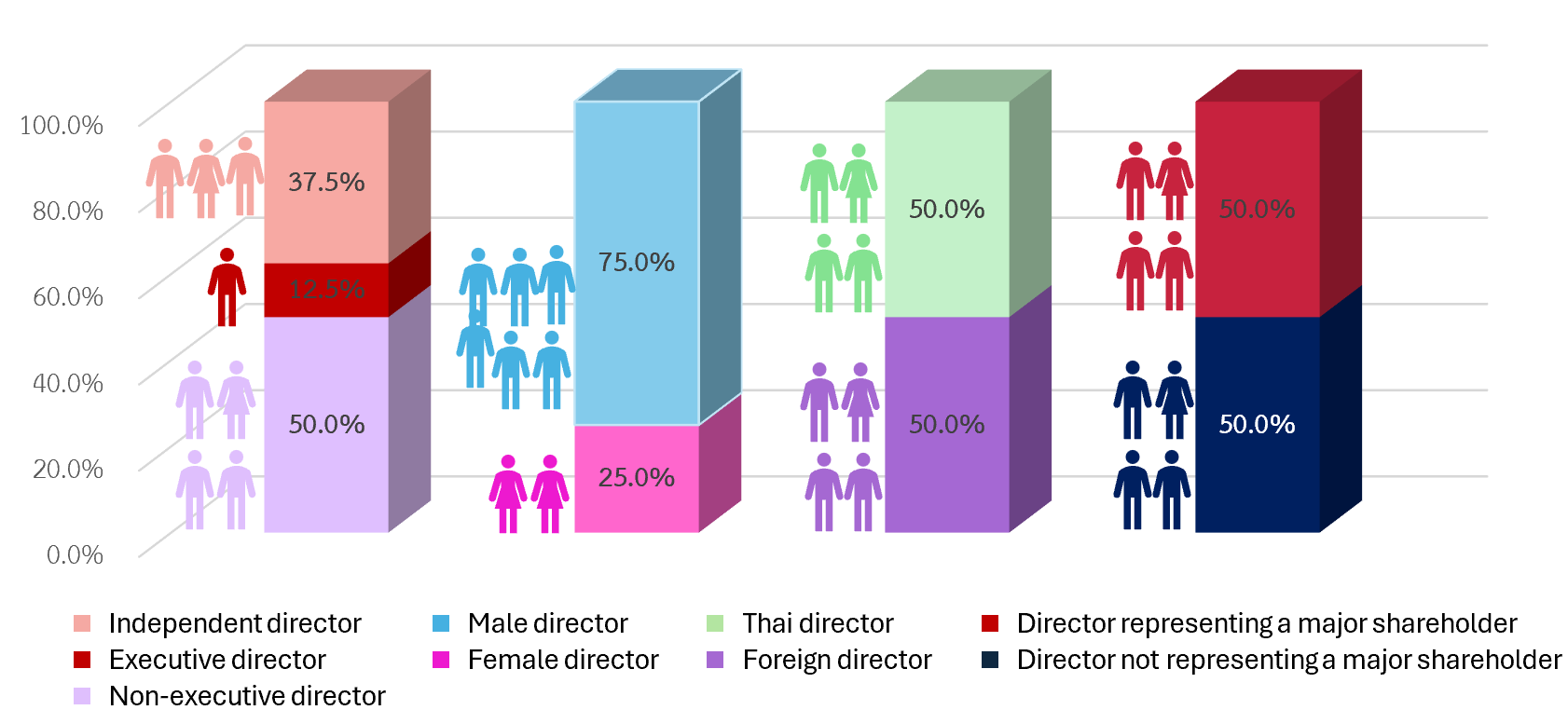
The Company places importance on diversity in the Board’s composition across multiple dimensions. Accordingly, it has established a policy to ensure that the Board is diverse in various respects, including experience, educational background, gender, race, and nationality. The Company has set targets for the Board to comprise at least 10% female directors of the total number of directors and to include at least one director with experience relevant to the Company’s business.

In 2025, the Company successfully achieved these targets. The Board of Directors comprises both Thai and foreign directors, including two female directors, three independent directors, and five directors with experience related to the Company’s business. In addition, independent directors represent more than one-third of the total Board members, and non-executive directors constitute half of the Board. This composition ensures independent and transparent decision-making while maintaining a proper balance of power in corporate governance.
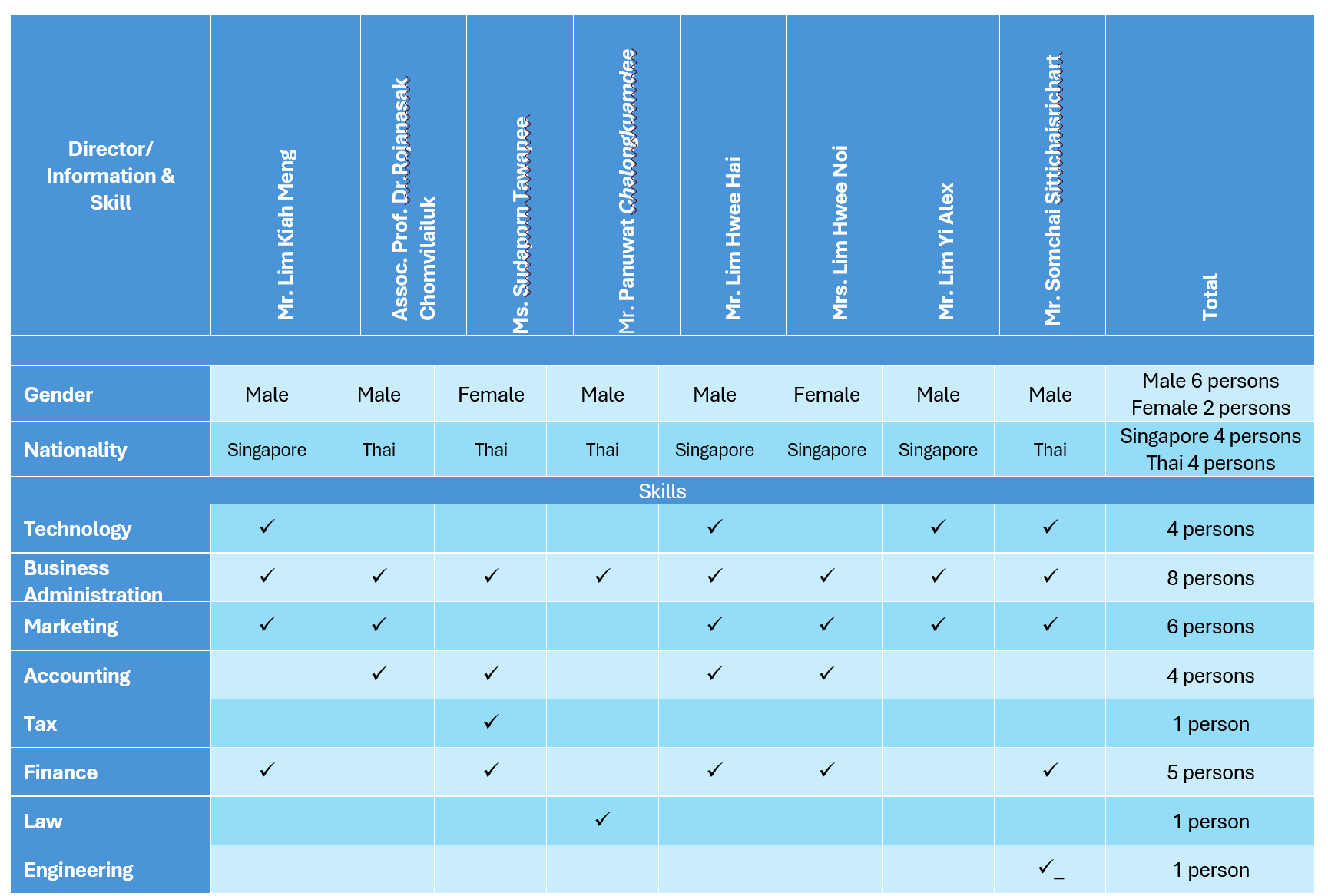
The Board of Directors’ Structure: The Board of Directors consists of 8 members. The Remuneration and Nomination Committee, under the delegation of the Board of Directors, has assessed and determined that the directors possess a diverse range of expertise, experience, and knowledge relevant to the Company’s business operations. This ensures effective corporate governance that maximizes benefits for shareholders and stakeholders.


In 2025, the Board of Directors comprises directors with extensive knowledge, capabilities, and experience across various fields, appropriate and aligning with the Company’s policy and strategy on Board diversity.

In addition to having non-executive directors with direct experience in the Company’s line of business, the Board of Directors unanimously resolved in 2018 to appoint Mr. Panuwat Chalongkwamdee, an independent director, as the Lead Independent Director. His primary responsibilities include coordinating with the Chairman to set meeting agendas, thereby enhancing the Company’s corporate governance framework.

Other guidelines regarding the board of directorsLeadership and Vision of the Board of Directors

The Board of Directors plays a pivotal role in setting the organization’s direction and vision, guided by the principles of sound corporate governance to create long-term value for shareholders and stakeholders. The Board of Directors comprises professionals with diverse expertise who exercise independent judgment and are capable of devising strategies that effectively respond to shifts in the business environment.
To ensure that the Company’s management adheres to good governance principles, the board follows these guidelines:

  • Clear Vision and Direction: The Board of Directors is committed to establishing long-term strategies, organizational objectives, and business plans that align with the Company’s mission. It promotes a corporate culture rooted in innovation, transparency, and sustainability, thereby building stability and confidence among shareholders and all stakeholders.

  • Accountability and Governance: The Board of Directors operates in strict adherence to legal standards, business ethics, and best practices as recommended by the relevant regulatory authorities such as the SET and the Thai IOD. This ensures that the Company maintains robust internal controls, transparency, and conducts business in a socially responsible manner.

  • Team Management and Sustainable Succession Planning: The Board of Directors fosters the development of the Management and employees to maximize their potential, supports effective teamwork, and implements succession plans for senior Management. This proactive preparation ensures continuity and stability in the Company’s operations, even in the face of unforeseen challenges.

  • Transparent and Reliable Communication: The Board of Directors advocates for the disclosure of accurate, comprehensive, and timely information to shareholders, regulatory bodies, and other stakeholders to ensure transparency and accountability.

  • Flexibility and Adaptability: In a rapidly changing environment, particularly in technology-driven sectors, the Board of Directors plays a crucial role in ensuring that the Company remains agile, adapts its strategies to evolving conditions, and is well-prepared to tackle emerging challenges.

Other guidelines regarding the board of directorsCorporate Governance Participation

The Company encourages all stakeholders to actively participate in a robust corporate governance framework by emphasizing transparency in information disclosure and providing accessible channels for feedback. The Company implements the following initiatives:

  • Governance-related information is shared through various channels, such as the Company’s website and the SET’s disclosure system, ensuring that shareholders and stakeholders can easily and comprehensively access the data.

  • The Company has established avenues for reporting fraud, corruption, or unethical practices via its website or through a dedicated complaint email (complain@sisthai.com), as well as direct communication with independent directors (independentdirector@sisthai.com).

  • A systematic complaint management system is in place, complete with structured data collection and a specialized task force that reviews suggestions and complaints. This framework is designed to proactively prevent issues, address concerns, and continually enhance the corporate governance system.

  • Corporate governance policies, including Codes of Conduct and related policies, are published on the Company’s website. The Company also ensures that its employees, partners, customers, and agents are well-informed about these policies to guarantee understanding and adherence to best practices via various channels.

Other guidelines regarding the board of directorsDisclosure on Security Trading by the Directors and the Management

To enhance transparency and prevent conflicts of interest, the Company requires the directors and the Management to disclose their transactions in the Company’s securities in accordance with sound governance practices as follows:

  • The directors and the Management must report any transactions involving the Company’s securities to the Board of Directors through the Company Secretary. This reporting is a standing agenda item at the quarterly board meetings.

  • Since 2014, the Company has instituted an additional requirement that the directors and the Management must notify the Board of Directors of at least 1 business day in advance before executing any transactions involving the Company’s securities.

Other guidelines regarding the board of directorsReports Stating the Interests and Security Holding of the Directors and the Management

The Company has established a process to review and report on the interests of directors and the Management, ensuring operations remain transparent and free from conflicts of interest. The requirements are as follows:

  • The directors and the Management are required to prepare a report of their own and related parties’ interests and submit it to the Company Secretary at least once a year. Any changes in the information must be reported immediately.

  • The Company Secretary is responsible for collecting these reports and submitting them to the Chairman of the Board of Directors and the Chairman of the Audit Committee.

  • This report contains critical information that enables the Company to comply with regulations on related-party transactions, which may give rise to conflicts of interest. It must adhere to the requirements set forth in the Securities and Exchange Act B.E. 2535 and the Capital Market Supervisory Board Notification No. TorJor. 2/2552.

  • The Company Secretary is tasked with maintaining these interest reports at the head office and providing copies to the Chairman of the Board of Directors and the Chairman of the Audit Committee to ensure transparent and effective oversight. The storage and submission of these documents may be conducted electronically.

Other guidelines regarding the board of directorsInternal Control and Audit System

The Company has established a systematic approach to monitoring and overseeing compliance with its internal control and risk management policies. The Board of Directors plays a critical role in ensuring that the Company maintains an effective and adequate internal control and risk management system to manage potential risks. This system encompasses the following key areas:

  • Control Environment: Fostering a corporate culture that emphasizes internal control and business ethics.

  • Risk Assessment: Establishing a framework for identifying, analyzing, and managing risks that may impact the Company’s objectives.

  • Control Activities: Implementing measures and control processes to prevent and mitigate operational risks.

  • Information and Communication: Strengthening internal communication channels to ensure the accurate and timely dissemination of critical information.

  • Monitoring: Continuously monitoring and evaluating the effectiveness of the internal control system.

To enhance the robustness of the internal control and audit system, the Board of Directors has appointed the Audit Committee to oversee and coordinate with the Quality Assurance Department. The Audit Committee plays a key role in reviewing and assessing the Company’s internal control system across the following eight core areas:

  1. Sales.

  2. Trade Receivables & Credit.

  3. Inventory.

  4. Procurement & Imports.

  5. Accounts Payable & Expenses.

  6. Repairs & Services

  7. Fixed Assets.

  8. Finance & Accounting

The Audit Committee regularly reviews internal audit findings with the Quality Assurance Department and discusses during the Audit Committee’s meeting. Additionally, the Audit Committee maintains close communication with the Risk Management Committee through its secretary to align audit activities with the Company’s risk assessment framework. This ensures that internal control measures are continuously adapted to evolving business conditions.

Furthermore, the Company conducts an annual assessment and review of the adequacy of its internal control system in accordance with the guidelines issued by the SEC. This process ensures that the internal control system remains relevant, up to date, and capable of effectively responding to changes in the business environment.

Policy & Practices — Shareholders and Stakeholders

Has Policy & Guidelines for Shareholders and Stakeholders

Yes

Shareholder & Stakeholder Guidelines

GuidelineDetail
Shareholder

Shareholders have the right to oversee the Company through the appointment of the Board of Directors and decision-making on significant matters, such as the purchase, sale, or transfer of shares, receipt of dividends, access to corporate information, and voting at shareholders’ meeting on issues such as director appointments, dividend payment, amendments to Company’s Article of Association, and changes in capital structure. The Company operates with transparency and efficiency to generate appropriate short-term and long-term returns while ensuring equitable treatment of all shareholders.

The Company respects and protects shareholder rights as stipulated by law and corporate regulations, particularly fundamental rights as follows:

1) Right to Participate in Shareholder Meetings and Vote on Key Matters

  • The Company holds shareholder meetings as required by law and facilitates broad and fair participation by shareholders through the following measures:

    • Distributing the invitation for the meeting along with supporting documents to shareholders at least 21 days in advance and publishing the invitation on the Company’s website at least 28 days before the meeting.

    • Holding meetings at convenient and appropriate locations for in-person meetings and providing electronic participation options.

    • Allowing shareholders to propose agenda items for the Annual General Meeting and nominate candidates for directorship via the Company’s website.

    • Providing shareholders the opportunity to ask questions and express opinions on each agenda item freely before voting, with a designated Q&A session at the end of the meeting.

    • Recording resolutions and shareholder inquiries in the meeting minutes for transparency.

    • Clearly defining shareholder voting rights. Ensuring equal voting rights for all shareholders, adopting a one-share-one-vote system.

    • Allowing shareholders to appoint proxies or independent directors to attend and vote on their behalf, with clearly defined proxy documentation that does not restrict participation.

    • Publishing clear instructions on meeting participation, voting procedures, and proxy appointments.

    • Implementing an electronic registration and voting system to ensure accuracy, transparency, and auditability, with vote summaries and records securely stored.

    • Enabling shareholders to request a secret ballot if at least 5 shareholders request it and the meeting approves it by majority vote.

    • Accurately documenting and publishing comprehensive meeting minutes with all essential details.

  • Annual General Meeting no. 1/2025 for the year 2025

    • Scheduled for Wednesday, April 23rd, 2025, to present financial results from January 1st, 2024, to December 31st, 2024.

    • Conducted exclusively via electronic means, utilizing the shareholder meeting and voting system provided by Digital Access Platform Company Limited, in compliance with the Emergency Decree on Electronic Meetings B.E. 2563 and related security standards issued by the Ministry of Digital Economy and Society. Clear instructions on meeting participation and voting procedures has been provided in advance.

    • Allowed shareholders to propose agenda items and nominate candidates for directorship from December 1st, 2024, to January 31st, 2025, with disclosures made via the SET’s news system and the Company’s website. No proposals or nominations were submitted.

    • Provided shareholders with opportunities to submit questions in advance via the Company’s website and addressed all inquiries during the meeting.

    • All members of the Board of Directors, the Financial Controller, the Company Secretary, and the Auditor have attended the meeting. Additionally, a legal advisor has been presented as a witness for the vote counting process.

    • The shareholders raised questions during the meeting, and the Company provided a complete response to the shareholder’s inquiry during the meeting.

    • Followed the pre-disclosed agenda without deviations or additional matters not listed in the meeting notice.

    • Published meeting resolutions on the SET and the Company’s website on the same day upon meeting completion.

    • Recorded and published comprehensive meeting minutes, including key inquiries and discussions, within 14 days post-meeting.

    • Provided details of past shareholder meetings on the Company’s website.

  • Annual General Meeting no. 1/2026 of the year 2026.

    • To be held on Monday, April 27th, 2026, to present financial results from January 1st, 2025, to December 31st, 2025.

    • Conducted exclusively via electronic means, utilizing a shareholder meeting and voting system that complies with the Emergency Decree on Electronic Meetings B.E. 2563 and relevant security standards issued by the Ministry of Digital Economy and Society.

    • Allowed shareholders to propose agenda items and nominate candidates for directorship from December 1st, 2025, to January 31st, 2026, with disclosures via the SET and the Company’s website. No proposals or nominations were submitted.

    • Provided shareholders the opportunity to ask questions during the meeting and submit questions in advance via the Company’s website.

    • Clearly communicated the meeting agenda and board recommendations for each agenda item to shareholders.

    • Published meeting details on the Company’s website.

  • External Assessment.

    • The SEC, in collaboration with the Thai Investors Association and the Thai Listed Companies Association, conducts an annual assessment of shareholder meeting quality. The Company has consistently received a 100% score since 2021.

2) Right to Receive Accurate, Complete, and Timely Information

  • Disclosure of essential and relevant business operation information in a transparent, clear, and timely manner through the SET’s channels and the Company’s website.

  • Regular dissemination of financial information, annual reports, and operating results via the Form 56-1 One Report.

  • Establishment of an Investor Relations Department to facilitate shareholders through various communication channels, as well as the creation of an investor relations webpage on the Company’s website to provide shareholders with necessary information.

  • Equal opportunity for stakeholders to access the Company’s information through activities such as quarterly Opportunity Day events in collaboration with the SET, financial analyst meetings, and regular business visits for investors, shareholders, and fund managers to engage with the Company’s Management.

3) Right to Receive Profit Distribution from the Company’s Operations

  • The Company has a dividend payout policy of approximately 40% of net profit after tax and legal reserves. However, the Board of Directors has the discretion to waive or modify this policy as deemed necessary for the best interest of shareholders. This may include reserving funds for debt repayment, reinvesting in business expansion, or adapting to changing market conditions th at could impact the Company's future cash flow.

  • The Company does not set a fixed dividend payout ratio for its subsidiaries. The dividend distribution from each subsidiary depends on its financial performance each year.

  • All shareholders have equal rights to receive dividends at a rate approved by the shareholders’ meeting.

4) Right to Buy, Sell, or Transfer Shares

  • Shareholders have the right to freely buy, sell, or transfer their shares unless restricted by laws, the Company’s Article for Association, or shareholder agreements.

Additionally, the Company has implemented fair measures to protect shareholder rights, including the following policies:

  • Conflict of Interest and Securities Holding Disclosure Policy

    • The directors and the Management must submit a report on their interests and those of related parties at least once a year or whenever there is a change, to be submitted to the Company Secretary.

    • The directors, the Management, and employees are prohibited from trading the Company’s securities from the end of each quarter until the financial statements are publicly disclosed. If trading is necessary during this period, prior approval from the Compliance Department is required.

    • The directors and the Management must report their securities transactions to the SEC under Section 59 when buying, selling, transferring, or receiving the Company’s securities.

  • Confidentiality and Insider Trading Policy

    • The directors, the Management, and employees are prohibited from using undisclosed financial and operational information for trading securities or for personal gain.

    • The directors and the Management must report their securities transactions to the Board of Directors through the Company Secretary.

    • Regular reminders are issued to the directors, the Management, and employees regarding the restriction on trading the Company’s securities during specified blackout periods each quarter.

  • Conflict of Interest Management Policy

    • Related-party transactions must be avoided unless they are necessary and beneficial to the Company. Any related-party transactions must be disclosed in advance to the Compliance Department or the Company Secretary and must be conducted under fair market terms as if dealing with external parties. Those with a vested interest must not participate in decision-making.

    • The directors and the Management must notify the Board of Directors via the Company Secretary at least one business day in advance before engaging in securities transactions.

Employee

The Company recognizes that employees are a fundamental pillar of sustainable success. Therefore, it places great emphasis on effective human resource management to foster a positive work environment and support employees in fully developing their potential. The Company implements the following policies and practices.
1) Fair and Equitable Employment and Termination

  • The Company maintains a transparent and fair recruitment and selection process, evaluating candidates based on their qualifications, skills, and experience. It also considers diversity and non-discrimination principles to ensure equal opportunities for all applicants. This commitment is reflected in equal employment opportunities in terms of workforce composition and average remuneration across genders, as well as in hiring individuals from diverse age groups, disadvantaged backgrounds, and persons with disabilities.

  • In cases of termination, the Company has an impartial review committee to ensure that the termination process is fair, transparent, and non-discriminatory.

2) Remuneration and Welfare

  • The Company places great importance on establishing appropriate remuneration packages, both short-term and long-term, that are fair and aligned with industry standards. This includes providing comprehensive benefits that comply with labor laws. Additionally, the Company has a channel through which employees can submit feedback or suggestions regarding benefits via the company's suggestion system, ensuring that the organization can continuously meet employee needs and enhance their quality of life effectively.

  • Remuneration is determined based on job value, with performance evaluations conducted every 6 months to inform annual salary adjustments. These evaluations also take into account employees' adherence to the Company’s Codes of Conduct.

  • In addition to base salaries, the Company offers various benefits, including:

    • Quarterly Bonuses: Based on the performance of the business units and the overall company results.

    • Annual Bonuses: Determined by the Company’s performance and individual employee contributions.

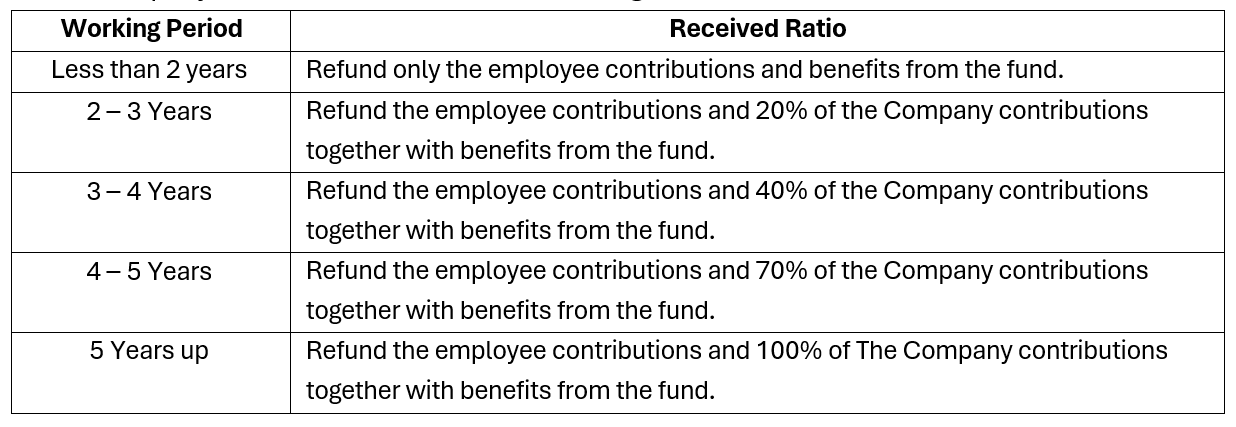
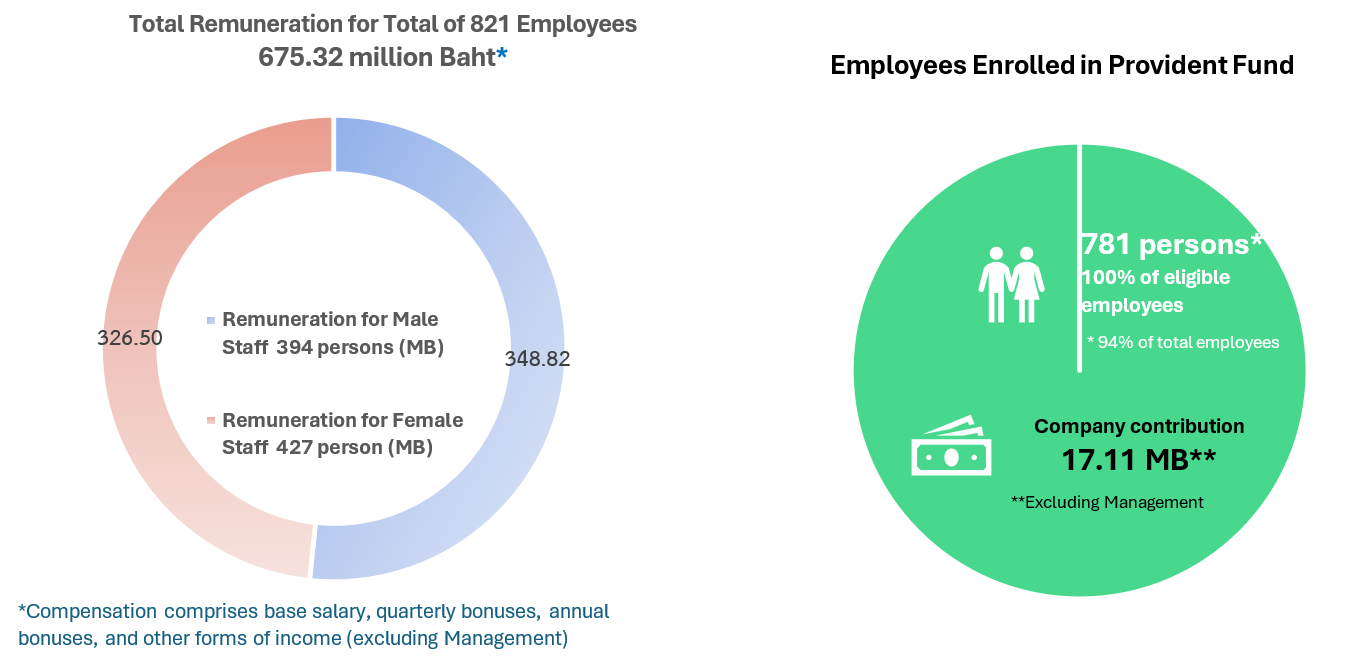
    • Provident Fund: The Company has established a provident fund and carefully selects fund managers who manage the fund responsibly under good governance principles. This fund is available to all employees who have passed their probationary period. Employees may voluntarily choose to contribute between 2% and 15% of their base salary to the fund. The Company will match employee contributions at the same rate, up to a maximum of 5% of the base salary. Employees will be entitled to the Company’s contributions based on their length of service as follows:

The Human Resources Department is supported by the Company in coordinating fund service providers to enhance knowledge in selecting investment policies and fund managers, as well as monitoring the management of investments in the provident fund. This is done in accordance with investment governance principles, selecting fund managers who adhere to these principles, and considering ESG factors to ensure the long-term benefit of the fund members. The fund manager selection criteria are disclosed to members to ensure transparency in the investment management process.

    • Accident Insurance: The Company provides accident insurance coverage for all employees with the following sum insured:

    • EJIP: Employees can join the EJIP or voluntarily participate in the Company’s stock purchases through salary deductions ranging from 1-10% of base salary, with the Company matching contributions. Employees become eligible for the Company’s contributions after 2 years in the program.

  • For the subsidiary, as the same employees are shared between the subsidiary and the Company, no additional compensation has been provided for the employees of the subsidiary.

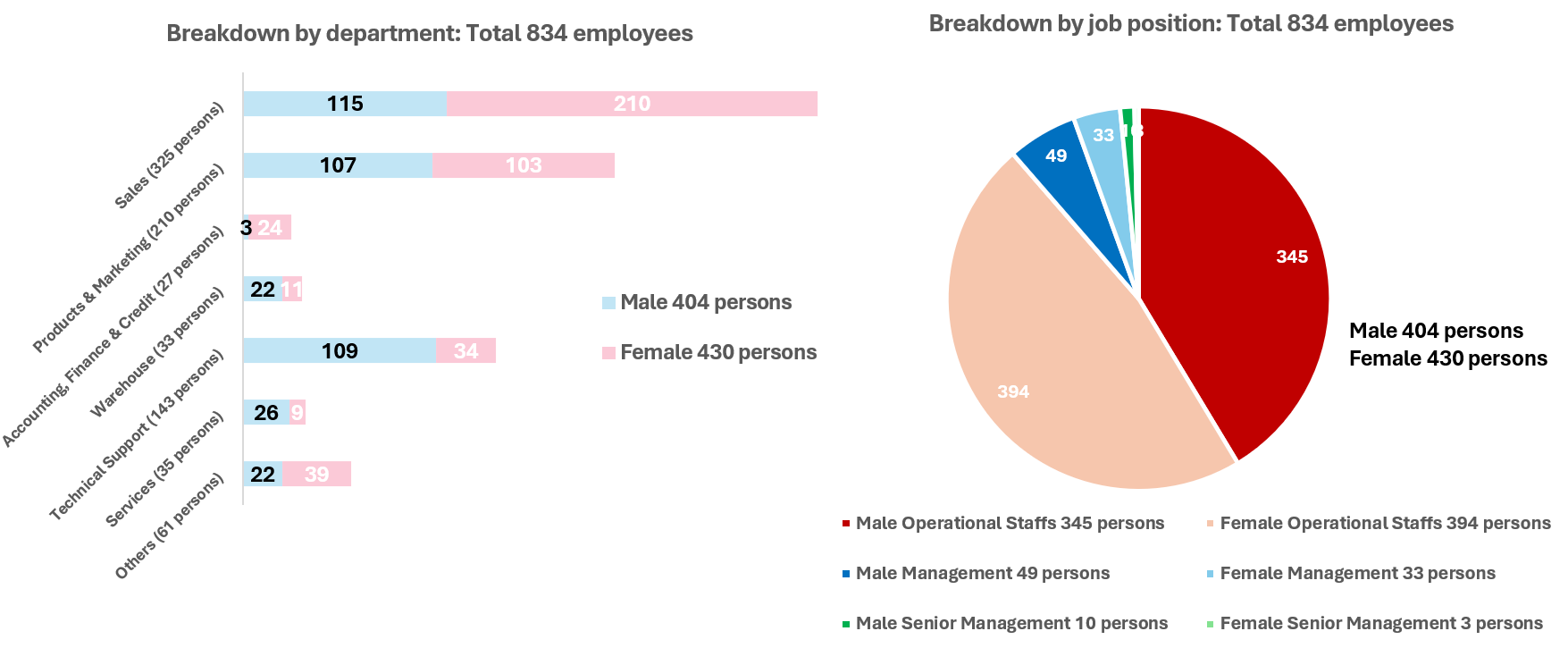
  • Information regarding the employment of Management and employees in 2025 is detailed as follows:

  • Information regarding employee remuneration in 2025 is detailed as follows:

Over the past 3 years, the number of employees has not changed significantly in a way that would impact the Company's operations. However, the Company continues to recruit additional employees to support its ongoing business expansion.

3) Employee Development

  • The Company supports continuous employee development through internal and external training programs to enhance essential skills, knowledge, and competencies for job performance, as well as to provide career growth opportunities.

  • The Company offers internal employees the opportunity to apply for open positions before external recruitment. Employees must undergo the same selection process as external candidates. Additionally, employees may request a transfer to a different function based on their expertise, subject to the Company’s consideration.

  • The Company promotes skill development in both core functions and supplementary areas to enhance work efficiency. This is facilitated through self-learning, training programs, and seminars to foster a positive mindset and support career growth within the organization.

  • In addition to in-house training, the Company invites external experts to conduct training sessions for newly appointed supervisors to enhance their managerial skills. Training programs required by manufacturers are also provided. The Company has a large conference room accommodating over 300 employees, along with medium and small meeting rooms equipped with modern facilities. An advanced E-Learning system is also available to facilitate employee training.

  • All new employees are required to complete an orientation program via the E-Learning system. The program covers key organizational information, employee benefits, work regulations, codes of conduct, and relevant policies, including the Anti-Bribery and Corruption Policy, Confidential Information Protection and Controlling the Use of Inside Information Policy, and Social and Environmental Policies. In 2025, 100% of new employees successfully completed the orientation training.

  • A mentoring system is in place for all new employees to support their integration into the Company’s culture, enhance their understanding of their roles, and improve work efficiency from the outset.

  • The Company allocates an annual budget for employee training, covering both internal and external training programs as appropriate.

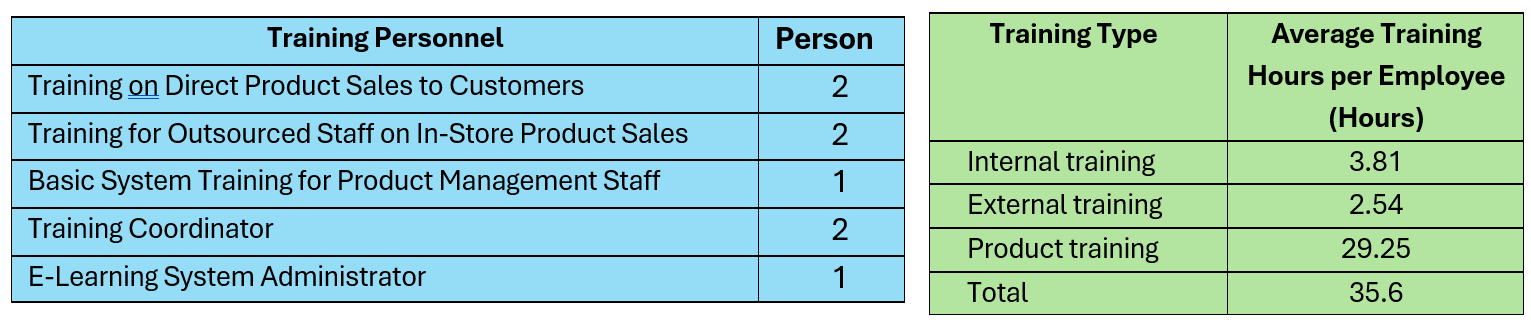
  • In 2025, the details of training personnel and the average training hours per employee are as follows:

4) Work Environment and Corporate Culture

  • The Company fosters a positive, safe, and respectful work environment where employees are treated equitably and encouraged to express their opinions and contribute ideas for organizational improvement. Additionally, the Company emphasizes a corporate culture that promotes teamwork, transparency, and business ethics.

  • The Company implements safety measures by designing workplaces that align with operational requirements, utilizing high-standard safety equipment, and providing tools to enhance employee safety.

  • To maximize work efficiency, the Company provides employees with appropriate tools and technology, including personal computers for all employees, portable computers with wireless communication systems for field staff, as well as an Electronic Workflow system and a data storage system to ensure convenient and swift access to essential information.

  • The Company grants a total of 12 days of paid annual leave and personal leave per year, which employees are entitled to from their starting date.

  • The Company maintains a transparent information disclosure policy by reporting monthly financial performance to employees to facilitate informed decision-making. Employees are also prohibited from trading the Company's securities from the end of each quarter until the Company has disclosed its financial results to the SET.

  • Employees are encouraged to freely express their opinions, or report concerns through a centralized database system, where feedback can be submitted either anonymously or with disclosure.

  • The Company values employee engagement and organizes various internal activities, such as annual events, team gatherings, and birthday celebrations with gifts for employees.

  • Based on the 2025 survey, the Company obtained the following insights:

    • A total of 88 employees voluntarily resigned, comprising 40 male and 48 female employees. This represents 10.73% of the average monthly workforce. Over 85% of these resignations were due to personal reasons.

    • The average employee tenure in 2025 was 7 years, showing a slight increase compared to the 2024 average.

5) Employee Health and Safety
The Company prioritizes employee health and safety by implementing various measures to create a safe working environment and enhance employees' well-being, as follows:

  • Health and Safety Measures: The Company provides appropriate personal protective equipment, conducts workplace safety training, and arranges annual health check-ups to ensure employees can perform their duties safely.

  • Annual Health Check-ups and Wellness Promotion: All employees undergo annual health check-ups to monitor their health conditions and receive medical advice on maintaining their well-being. Additionally, the Company supports influenza vaccinations by covering 50% of the cost.

  • Workplace Hygiene and Environment: The Company promotes basic hygiene practices by ensuring a clean workplace, proper ventilation, adequate lighting, and sufficient handwashing and restroom facilities. Employees are also encouraged to contribute to maintaining cleanliness in the workplace.

  • First Aid Equipment and Medical Room: The Company provides adequate first aid equipment and conducts basic first aid training for relevant employees. A medical room is also available for initial medical assistance.

  • Safety Training: Safety training is incorporated into the orientation program for new employees, with ongoing training sessions provided to enhance awareness and competency in safe work practices.

  • Promoting Employee Safety and Occupational Health:

    • Conduct fire evacuation training and drills in collaboration with the building owner and property management of the leased premises at least once a year, covering evacuation procedures, assembly points, and designated roles and responsibilities during emergencies.

    • Provide training on fire extinguisher use and basic emergency response.

    • Carry out workplace environment and risk inspections, such as checking electrical equipment, maintaining good housekeeping, keeping emergency exit routes clear of obstructions, and designating smoking areas with a strict no-smoking policy in work areas and warehouses.

    • Communicate safety alerts and promote safety awareness through signage, notices, and electronic communications to reinforce key safety requirements.

  • Accident Recording and Monitoring: The Company maintains an electronic “Accident Occurrence” database to record and consolidate data on accidents and incidents across all work areas and relevant activities. The database enables employees, supervisors, and relevant functions to monitor cases, analyze root causes, and implement corrective and preventive actions to systematically reduce recurrence.

6) Employee Rights and Workplace Fairness
The Company is committed to upholding employee rights and fostering a fair, transparent , and non-discriminatory work environment by implementing the following measures:

  • Compliance with Labor Laws and Human Rights Standards: The Company strictly adheres to labor laws and human rights principles, prohibiting discrimination, harassment, and unfair labor practices. All employees are treated equally and are entitled to fair remuneration, benefits, and career advancement opportunities.

  • Grievance and Feedback Mechanisms: The Company provides a secure and confidential channel for employees to report concerns or submit feedback. Employees are assured protection from retaliation or adverse consequences for exercising this right.

  • Freedom of Association and Collective Bargaining: The Company respects employees' rights to form or join legally recognized groups and will not interfere with or obstruct their rights in collective bargaining processes.

  • Effective Resolution of Grievances: The Company promotes a transparent and efficient grievance resolution system, allowing employees to freely express concerns and report issues. All grievances are addressed fairly and appropriately, ensuring that employees’ voices are heard and considered.

7) Performance Evaluation and Motivation
The company has a clear and fair performance evaluation system to serve as a guideline for improving employee efficiency. This system also supports performance-based rewards and compensation, serving as an incentive for employees to work effectively and maintain job satisfaction.

Customer

The Company recognizes the importance of customers as key business partners contributing to its success. It is committed to conducting business responsibly, transparently, and with a strong focus on customer satisfaction. The Company prioritizes product and service quality, fairness in business operations, sustainable development, and fostering long-term customer relationships. The key practices include:
1) Responsible Sales and Services

  • Selecting and offering high-quality, safe, environmentally friendly, and innovative products to enhance customer convenience.

  • Treating all customers fairly, without discrimination, and adhering to ethical business principles.

  • Providing high-quality after-sales services with a comprehensive service center network nationwide.

  • Establishing measures to prevent and address potential issues, ensuring the best possible customer experience

2) Transparency in Product and Service Communication

  • Providing accurate, complete, and sufficient information about products and services, including any potential impacts.

  • Advertising products and services truthfully, without distortion or misleading claims.

  • Utilizing accessible communication channels such as websites, product labels, user manuals, and social media.

  • Establishing a systematic channel for receiving and handling product and service-related complaints.

3) Enhancing Customer Satisfaction and Relationships

  • Conducting regular customer satisfaction surveys and using the insights to improve products and services.

  • Organizing customer engagement activities such as special discounts and promotional updates.

  • Assigning dedicated personnel to coordinate with customers, address concerns, and enhance service quality.

4) Enhancing Customer Satisfaction and Relationships

  • Complying with data security standards, with no history of customer data breaches.

  • Strictly adhering to the Company’s personal data protection policy and informing customers of data protection measures.

5) Sustainable Growth and Development with Customers

  • Promoting knowledge of new technologies through training sessions and seminars led by industry experts.

  • Supporting customers in adopting technology to enhance operational efficiency and strengthen system and data security.

  • Provide credit advisory support to customers to help them access financing more easily.

  • Organize regular product and technology showcases to introduce new technologies and relevant innovations for customers to consider and adopt.

Business competitor

The Company is committed to conducting business under the principles of free and fair competition, believing that transparent and fair competition is a key mechanism in enhancing industry efficiency and market growth. The Company has established the following guidelines for dealing with business competitors:
1) Fair Treatment of Competitors

  • Conduct business with integrity and fairness, refraining from any actions that may restrict or distort competition, including the dissemination of false information or defamation that could harm the reputation or business of competitors.

  • Avoid agreements or collaborations with competitors or other businesses that could lead to monopolization, reduction of competition, or violations of competition laws.

  • Refrain from engaging in unlawful anti-competitive practices, including illegal price manipulation, bid-rigging, prohibited boycotts, market allocation, restrictions on competition, and coercing customers into exclusive supplier agreements.

  • Do not seek or use competitors’ trade secrets through improper or dishonest means.

2) Compliance with Legal Frameworks

  • Strictly comply with competition laws and regulatory requirements to ensure that the Company’s business operations remain within legal and ethical boundaries.

  • Educate and raise awareness among employees regarding competition laws to ensure they perform their duties correctly and in alignment with the Company’s practices.


In 2025, the Company and its subsidiaries had no legal disputes or complaints with trade competitors, and did not enter into any agreements with competitors or other business operators that would create a monopoly or reduce competition in the market.

Business partner

The Company conducts business with its partners in a professional, transparent, and fair manner to foster sustainable and mutually beneficial relationships. The Company is committed to adhering to transparent and fair procurement principles, taking into consideration product quality, social responsibility, and ethical business practices, as outlined below:
1) Procurement Criteria

  • The Company upholds a transparent, fair, and non-discriminatory approach in selecting business partners with the capability to operate sustainably. The selection process considers product quality, operational standards, on-time delivery, good governance, anti-corruption compliance, and adherence to human rights principles.

  • The Company's procurement process is conducted transparently and fairly, without discrimination.

  • Business partners must comply with labor laws, human rights regulations, and codes of conduct.

2) Enhancing Business Partners’ Capabilities and Capacity

  • The Company promotes collaboration with business partners to develop products, services, and innovations that strengthen capabilities and create shared value for both the Company and its partners.

  • The Company encourages business partners to operate in accordance with ethical principles and applicable compliance requirements, including due consideration of labor practices, human rights, safety, occupational health, and environmental matters, in order to advance sustainable business practices together.

  • The Company continuously conducts training and seminars with business partners to enhance knowledge and capabilities in products, technologies, service delivery approaches, quality and safety standards, as well as governance and sustainable business practices.

  • The Company supports collaborative development and co-creation with business partners to enhance delivery capabilities and improve operational efficiency across the supply chain.

  • The Company monitors and evaluates projects and activities carried out jointly with business partners to review achievements and challenges and to define follow-up improvements that deliver tangible outcomes.

  • The Company collects feedback and real-world usage data from both internal operations and customers, and reviews such information jointly with business partners to support further improvements to products and services to better align with actual use cases. In many cases, business partners have been able to use these insights to refine and enhance their products to better meet end-user needs.

  • The Company shares knowledge and technical recommendations derived from its delivery and customer support experience with business partners, enabling them to develop or improve product features, supporting documentation, and after-sales service practices with greater clarity and effectiveness.

3) Measures for Fairness and Codes of Conduct for Business Partner

  • The Company has established a Codes of Conduct for Business Partner to guide business operations in an appropriate, transparent, and fair manner.

  • The Company respects the human rights and intellectual property rights of its business partners and encourages compliance with labor, environmental, and governance standards.

  • Business partners have the opportunity to file complaints if they encounter unfair business practices through designated company channels. In 2025, the Company did not receive any complaints regarding unfair business practices.


4) Guidelines for Cooperation and Mutual Growth

  • The Company treats business partners fairly and equitably in accordance with contractual agreements.

  • The Company fosters capability development and knowledge exchange with business partners through training and seminars, followed by post-training assessments, which have demonstrated overall positive results, indicating an improvement in employee knowledge and understanding.

  • A dedicated unit is responsible for reviewing and analyzing business partner data to identify opportunities for development and product sourcing to maximize mutual benefits.

  • The Company leverages technology to enhance operational efficiency, such as electronic payment systems.

  • The Company supports business partners in introducing new products and technologies to the Thai market.

  • The Company provides additional welfare benefits for employees of contracted agent working with the Company as mentioned in item 3.5.2.4.

  • Regularly collaborate with partners to organize product and technology showcases to promote the introduction of new technologies and innovations, and to strengthen cooperation in technology, information sharing, and market insights between the Company and partners.

Creditor

The Company recognizes the importance of creditors as key stakeholders in its business operations, particularly financial institutions providing loans and trade creditors extending credit terms. The Company therefore places great emphasis on treating creditors fairly, transparently, and responsibly, including the disclosure of accurate, complete, truthful, and timely information, in order to strengthen confidence and maintain stable and sustainable business relationships.
The Company has established policies and practices for creditor management covering information disclosure, compliance with loan repayment terms, the establishment and maintenance of guarantee and collateral requirements, capital and liquidity management, as well as measures to prevent and manage default risk. As a result of adhering to these policies and practices, the Company has never defaulted on its obligations to creditors. Details are as follows:
1) Policy on Fair and Responsible Treatment of Creditors

  • Fair, transparent, and auditable practices: The Company treats creditors fairly and without discrimination, conducts transactions in good faith, and strictly complies with applicable laws, rules, regulations, and relevant financial agreements.

  • Disclosure to creditors: The Company discloses accurate, complete, truthful, and timely information to support creditors’ financial considerations. The Company also provides advance notice to creditors where significant events or risks may affect its financial position, debt servicing capacity, or compliance with contractual terms.

  • Guarantee and collateral requirements: The Company provides and maintains guarantees and collateral in an appropriate and transparent manner in accordance with the terms agreed with creditors. It strictly uses collateral or pledged assets in line with the purpose and requirements specified in the agreements and refrains from any action that could impair collateral value or unnecessarily affect creditors’ rights.

  • Capital and liquidity management: The Company manages liquidity prudently and efficiently to ensure continuous ability to meet debt obligations as they fall due. It prepares and regularly reviews cash flow plans and working capital management to ensure adequate funding for financial commitments.

  • Default prevention: The Company regularly monitors and assesses its debt servicing capacity, including compliance with contractual covenants, and establishes contingency funding and liquidity plans for unforeseen circumstances. It also implements financial risk management guidelines to minimize the likelihood of default.

2) Creditor Management Practices

  • Compliance with repayment terms: The Company repays principal, interest, fees, and other obligations according to the agreed schedule, and completes required documentation and communications with creditors in accordance with established procedures.

  • Guarantee and collateral compliance: The Company prepares information and documentation in line with contractual requirements, monitors collateral status to ensure ongoing compliance, and promptly rectifies any issues that may lead to non-compliance. It also obtains creditors’ consent prior to taking any action that requires approval under the relevant agreements.

  • Capital management: The Company prepares cash flow forecasts and advance debt repayment plans to ensure sufficient funds are available for each payment cycle and maintains debt levels and financial commitments within an appropriate range relative to the Company’s financial position.

  • In the event of heightened risk or covenant breach: Where delays or default risk are anticipated, the Company promptly notifies creditors and provides feasible remediation plans. Where appropriate, the Company may coordinate with creditors to negotiate debt restructuring and/or additional terms to achieve a fair outcome for all parties.

Government agency

Given the Company's business operations involving importation and product sales, it is necessary to engage with various government agencies throughout multiple stages, including import procedures, customs clearance, permits, certifications, and distribution. The Company is committed to full compliance with all applicable laws, regulations, and government directives to ensure that its operations are conducted legally, transparently, and in accordance with established standards. To achieve this, the Company has established the following measures:

1) Transparency and Fairness

  • Conduct all interactions with government agencies with transparency, integrity, and strict adherence to relevant regulations and guidelines.

  • Prohibit employees and company representatives from offering or accepting bribes or any improper benefits from government officials or agencies.

2) Disclosure and Reporting

  • Comply with disclosure requirements set by regulatory authorities, including financial reporting, material corporate information, and significant transactions.

  • Prepare and submit the annual report and Form 56-1 One Report in accordance with the regulations of the SEC and the SET.

3) Awareness and Compliance Culture

  • Provide employees training on relevant laws and regulations.

  • Establish and communicate the Company's Code of Business Conduct and Anti-Bribery and Corruption Policy to employees and relevant stakeholders.

4) Internal Controls and Auditing

  • Implement a robust internal control system, including risk assessments and internal audits, to ensure compliance with applicable laws and regulations.

  • Assign the Audit Committee and Quality Assurance Department to oversee and monitor compliance with relevant requirements.

  • Establish a secure and confidential whistleblowing mechanism for reporting suspected legal or regulatory violations.

Community and society

The Company recognizes the importance of conducting business responsibly towards the community and society. It is committed to adhering to good corporate governance principles while complying with applicable laws and international standards to create a sustainable positive impact on society. The Company has established the following key practices:
1) Anti-Corruption and Fraud

The Company places great emphasis on transparency and business ethics, strictly prohibiting the directors, the Management, and employees from engaging in any form of corruption. Preventive measures include:

  • Developing and publicly disclosing an Anti-bribery and Corruption Policy as a guideline for operations.

  • Continuously managing and reviewing corruption-related risks.

  • Assigning the Audit Committee, in collaboration with the Risk Management Committee, to oversee and manage corruption-related risks.

  • Implementing effective internal controls and audit mechanisms.

  • Establishing whistleblowing channels and ensuring whistleblower protection, with appropriate measures to safeguard complainants. In 2025, no incidents of corruption or fraud were reported within the Company.

2) Community and Society Development Engagement
The Company is committed to creating value for the community and society through initiatives in education, environmental protection, and public health, focusing on sustainability and tangible outcomes, including:

  • Community Development Projects: To support access to information technology and expand educational opportunities for underprivileged children and youth, the Company donated 20 notebook computers that had reached the end of their internal service life but remained in good working condition to children and youth in Chiang Rai Province. The laptops will be used to search for additional knowledge beyond classroom lessons, as well as to complete homework and other assignments from their schools.

  • Employment Opportunity Programs: Promoting local employment, particularly for recent graduates, the elderly, and persons with disabilities, to foster sustainable livelihoods.

  • Safe Driving Initiative: Providing transportation insurance for delivery personnel, marking the 11th consecutive year of implementation.

  • Employee Training and Development: Enhancing skills and professional growth opportunities for employees at all levels.

3) Human Rights Implementation Measures
The Company is committed to upholding international human rights standards and ensuring fair treatment of employees, business partners, and stakeholders through the following measures:

  • Developing and publicly disclosing a Human Rights Policy as an operational guideline.

  • Promoting a fair and discrimination-free work environment.

  • Prohibiting child labor and forced labor.

  • Supporting diversity and equality, ensuring non-discrimination in all aspects.

  • Continuously managing and reviewing human rights risks, with regular reporting to the Risk Management Committee and the Corporate Governance and Sustainability Committee.

  • Implementing mechanisms to prevent and address human rights violations.

In 2025, the Company revised its human rights policies and practices in line with relevant regulations and additional recommendations from partners and customers. No reports of human rights violations or related complaints were received.

4) Personal Data Protection
The Company places strong emphasis on safeguarding confidential information and the personal data of business partners, customers, and representatives, as well as employee and other stakeholder data. The Company publicly discloses its Personal Data Protection Policy on its website and manages personal data in accordance with the Personal Data Protection Act B.E. 2562 (2019), covering the following key areas:

  • Collects, uses, discloses, shares, transfers, and retains personal data securely, strictly for specified purposes and only to the extent necessary.

  • Implements access control measures, such as restricting user access, storing data in secure systems, and protecting data throughout its lifecycle.

  • Upholds data subject rights, including the right to access, rectify, withdraw consent, object to processing, and lodge complaints.

  • Provides complaint channels and contact details for the Personal Data Protection Officer (DPO) as specified in the Personal Data Protection Policy, which is accessible via the Company’s website.

  • Upon receipt of a complaint, follows established procedures, including case intake, fact-finding, risk and impact assessment, corrective and preventive actions, and communication of outcomes to the complainant. In the event of a data breach, an incident response mechanism is activated in accordance with defined procedures.
    In 2025, the Company received no reported complaints regarding personal data breaches.

5) Information Technology Security
The Company prioritizes the security of its information and IT systems to prevent cyber threats and mitigate potential risks. Measures include:

  • Establish stringent cybersecurity standards and develop a publicly disclosed IT Security Policy, which is reviewed annually by the Board of Directors as a guideline for operations..

  • Continuously manage and review information security risks, including regular internal audits.

  • Leverage technology to monitor, detect, and mitigate cybersecurity threats proactively.

  • Conduct employee training programs to enhance awareness of information security.

  • Regularly assess and enhance security systems.

Code of Conduct

Has a Business Code of Conduct

Yes

Code of Conduct Description

The Company operates its business with a strong commitment to ethical principles and corporate governance, emphasizing transparency, integrity, and fairness to build trust among all stakeholders, including employees, business partners, customers, shareholders, regulatory authorities, and society.

To guide business operations, the Company has established a Business Code of Conduct covering key areas such as:

  • Responsibilities to the Company and shareholders.

  • Responsibilities to employees, customers, business partners, and competitors.

  • Responsibilities to creditors and financial institutions.

  • Responsibilities to regulatory authorities.

  • Responsibilities to society, communities, and the environment.

Additionally, the Company has developed relevant policies to reinforce clear operational guidelines and has established a Code of Conduct for Business Partners to ensure that customers, partners, and agents adhere to ethical standards aligned with the Company’s values.

The Company communicates the Business Code of Conduct to all directors, the Management, and employees to raise awareness through electronic channels such as email, the Company’s platform and website.

The Business Code of Conduct is reviewed and approved annually by the Board of Directors to ensure its relevance and alignment with applicable laws, regulations, and stakeholder expectations across the supply chain. The Quality Assurance Department is responsible for regularly monitoring compliance with the Codes of Conduct.

The Company encourages employees and stakeholders to report any violations of the Business Code of Conduct through designated reporting channels, with appropriate whistleblower protection measures in place. In 2025, no violations of the Business Code of Conduct were reported, reflecting the Company's strong culture of integrity and commitment to sustainable business practices.

To ensure accessibility for all stakeholders, the Company has disclosed the Business Code of Conduct and related policies in Attachment no.5 of Form 56-1 One Report and on the Company’s website.

Code of Conduct Practices

GuidelineOther — Please SpecifyDetail
Prevention of Misuse of Inside Information

The Company prioritizes transparent management of conflicts of interest and has established a Conflicts of Interests Management Policy to guide its operations. The directors, the Management, and employees are required to avoid activities that may compromise the Company’s interests. All related-party transactions must be carefully and transparently considered. Details of this policy are available in Attachment no. 5 of the Form 56-1 One Report and on the Company’s website.

Anti-corruption

The Company is committed to combating bribery and corruption in all forms, both direct and indirect. An Anti-Bribery and Corruption Policy has been established to serve as a guideline for the directors, the Management, and employees.

Reports or complaints regarding corruption can be submitted through designated reporting channels as outlined in the Anti-Bribery and Corruption Policy, which is disclosed in Attachment no.5 of the Form 56-1 One Report and on the Company’s website.

Additionally, in 2024, the Company became a member of the Thai CAC, reaffirming its commitment to upholding the highest ethical standards and full compliance with anti-corruption regulations at both national and international levels.

Whistleblowing and Protection of Whistleblowers

Complaints Managing Procedure

The Company designates the Audit Committee as responsible for managing complaints related to non-compliance with the Anti-Bribery and Corruption Policy. A specific committee will be appointed to assess and handle complaints and clues on a case-by-case basis. The appointment of this committee will prioritize independence and appropriateness in addressing the specific complaints.

The procedures for managing clues and complaints related to corruption are as follows:

  1. The person receiving the clues or complaints shall report such information to the Quality Assurance Department for an initial assessment prior to further report to the Audit Committee.

  2. If the preliminary assessment reveals the validity of the complaint or disclosure, the Audit Committee will appoint a specific committee to gather facts, evidence, and conduct a thorough investigation.

  3. The specific committee will present details of clues or complaints, along with the facts and evidence, to the Audit Committee for evaluation and consideration. This process typically takes approximately 30-60 days (depending on the complexity of facts-finding).

  4. The Audit Committee reviews and assesses the clues and complaints to develop a plan for taking punitive action against the wrongdoers, in accordance with the established penalty outlined.

  5. The Audit Committee evaluates and considers the damage incurred by both the affected parties and the complainants to develop measures for mitigating the impact on those affected and implementing protective measures for the complainants.

  6. In cases that fall under the criteria that must be reported to the Board of Directors, the Audit Committee shall present the investigation report, the punishment and mitigation guidelines, including its implementation to the Board of Directors.

  7. In case the whistleblowers or the complainants reveal themselves, the specific committee will inform them of the results within 7 business days after the case is concluded.

Complainants and Whistleblower Protection Measures

  1. The Company will not disclose the names and information of the whistleblowers or complainants.

  2. The Company will treat information related to clues and complaints as confidential, only disclosing it as necessary for processing and assessing the clues and complaints, with a primary focus on the safety and protection of the whistleblowers, complainants, and affected parties.

  3. In cases where the Audit Committee assesses the situation and finds that there is an impact on the whistleblowers or complainants, the committee will take fair and appropriate measures to protect the whistleblowers or complainants, tailored to specific circumstances.

  4. In situations where the whistleblowers or complainants are in circumstances that are not safe or where they may be at risk of harm because of their disclosures and complaints, they are encouraged to request the company to establish appropriate protective measures.

  5. The Company will not consider degrading, punishing, or having negative impact on the employees who refuse the fraud and corruption even such refusion may cause the Company business opportunity lost.

Preventing the Misuse of Inside Information

The Company recognizes the importance of safeguarding confidential information and preventing the misuse of inside information for personal gain. Accordingly, the Company has established a Confidential Information Protection and Controlling the Use of Inside Information Policy as an operational framework. These policies prohibit directors, executives, and employees from using the Company’s non-public information to trade securities or to obtain personal benefits.

In addition, the Company requires directors and executives to report their securities transactions, as well as those of their related persons, to the Company to enable transparent monitoring. Directors, executives, and employees are also required to refrain from trading the Company’s securities during the quarter-end period until the Company’s financial statements are publicly disclosed. The confidentiality and insider trading policies are disclosed in the Form 56-1 One Report (Attachment no.5) and on the Company’s website.

Prevention of money laundering

The Company places great importance on complying with applicable laws and regulations on anti-money laundering and counter-terrorism financing. The Company has established a clear Anti-Bribery and Corruption Policy to ensure that its business operations are transparent and secure, and to prevent the Company from being used as a channel for money laundering or the financing of terrorism. This policy is disclosed in the Form 56-1 One Report (Attachment no.5) and on the Company’s website.

The Company prohibits directors, executives, and employees from being involved in money laundering or the financing of terrorism in any form, whether directly or indirectly. The Company also maintains risk management and internal control measures that cover these matters.

Giving or receiving gifts, entertainment, or business entertainment

The Company recognizes the importance of preventing fraud and corruption that may arise from the giving or receiving of gifts, assets, or business hospitality. Accordingly, the Company has established Receiving or Giving of Gifts, Assets, or Other Benefits Policy to serve as a guideline for employees in the performance of their duties.
Under this policy, directors, executives, and employees are prohibited from giving or receiving gifts, money, or any other benefits that could influence business decisions or induce any person to perform duties improperly. The policy also requires that business entertainment and hospitality be reasonable and appropriate, as specified in the Company’s policy on the giving and receiving of gifts, assets, or other benefits, which is available in Attachment no.5 of the Form 56-1 One Report and on the Company’s website.

Compliance with laws, rules and regulations

The Company is committed to complying with all applicable laws, regulations, and ethical standards relating to its business operations, both domestically and internationally. The Company has implemented rigorous processes to ensure that all of its activities comply with relevant trade compliance requirements. Accordingly, the Company has established a Trade Compliance Policy to serve as an operational guideline. This policy is disclosed in Attachment no.5 of the Form 56-1 One Report and on the Company’s website.

Use and maintenance of data and assets

The Company places importance on safeguarding and using the Company’s assets efficiently. Accordingly, the Company has established a Protecting and Using of the assets of the Company Policy as a guideline. Under this policy, all directors, executives, and employees are responsible for using the Company’s assets appropriately and are prohibited from using such assets for personal gain or for the benefit of others, in order to ensure the Company’s business operations are conducted smoothly and efficiently.

Anti-competitive

The Company is committed to conducting its business in accordance with good corporate governance principles and competing fairly in the marketplace. To ensure that its operations do not result in unfair restrictions on competition, the Company has set out unfair competition and antitrust guidelines under its Trade Compliance Policy as an operational framework.

The Company maintains a policy of refraining from any actions that may restrict or distort fair trade competition. The Company will not enter into agreements or arrangements with competitors or other business operators that could lead to monopolization, reduced competition, or violations of applicable competition laws. This includes, without limitation, illegal price fixing, bid rigging, unlawful boycotts under applicable laws, market allocation, other unlawful restraints of trade, and forcing customers to use specific distributors.

Cyber security

The Company places strong emphasis on the security of data and information technology systems. The Company has established an Information Systems Security Policy to protect its information assets and to safeguard data against unauthorized access. The policy covers access controls, network management, and cyberattack prevention, as well as the management of the Company’s information assets. All executives and employees are required to comply with the Company’s security policies and guidelines.

In addition, the Company has defined procedures and measures for risk assessment and for responding to information security incidents and provides training to employees to enhance awareness and knowledge of information security.

Environmental management

The Company is committed to conducting business responsibly with due regard for the environment and has implemented environmental management practices in compliance with applicable laws and relevant requirements. The Company emphasizes environmentally friendly procurement and the offering of products that are safe for users and the environment. The Company also aims to reduce air pollution and GHG emissions through the use of transportation technology and efficient energy management.

Human rights

The Company is committed to protecting and respecting the human rights of all stakeholder groups, based on principles of equal treatment and respect for individual rights in all aspects. Accordingly, the Company has established a Human Rights Policy covering the promotion and respect of human rights protection in accordance with applicable laws and relevant international treaties and standards. The Company adheres to fair labor practices, non-discrimination, and opposes human trafficking and human rights violations across all areas of its business.

In addition, the Company emphasizes compliance with occupational health and safety principles, does not support child labor, and provides multiple channels for receiving complaints related to human rights violations. This is to ensure transparent and ethical operations and respect for the rights of all relevant parties. The Human Rights Policy is disclosed in Attachment no.5 of the Form 56-1 One Report and on the Company’s website.

Occupational health and safety

The Company is committed to providing a safe and healthy working environment. The Company has developed a safety management system in line with labor laws and relevant standards, including risk assessments to prevent potential hazards in work processes.

The Company also emphasizes the provision of appropriate resources, such as personal protective equipment (PPE), fire prevention systems, and fire evacuation drills. In addition, the Company provides training on occupational health and safety and promotes employee well-being through annual health check-ups and medical benefits. The Company collects and maintains data for accident analysis and root-cause identification to implement preventive and corrective actions, thereby effectively reducing workplace risks and ensuring that all employees work in a safe and healthy environment.

Other guidelines related to business code of conductOther Business Ethics Practices Relating to Business Codes of Conduct

In addition to the aforementioned policies and guidelines, the Company has established other related policies, which are disclosed in Attachment no. 5 of the Form 56-1 One Report and on the Company’s website as part of its commitment to responsible business practices.

Promoting Compliance with the Code of Conduct

Promotes Compliance by Directors, Executives and Employees

Yes

Description

The Company reviews and submits the Codes of Business Ethics and related policies to the Board of Directors for consideration and approval on an annual basis. The Company also communicates and provides training to Management and employees through electronic channels, together with assessments to evaluate understanding. Compliance with the Codes of Business is included as a topic and component of performance evaluations to promote consistent and organization-wide adherence.

Anti-Corruption Networks & Projects

Joined or Declared Intent to Join Anti-Corruption Networks

Yes

Networks & Projects Joined

Network / ProjectCAC Certified
Thai Private Sector Collective Action Against Corruption: CACY
United Nations Global Compact (UNGC)
Participation of anti-Corruption networks and initiatives

Material Changes & Developments in CG

Reviewed the CG Policy or Board Charter in the Past Year

Yes

Material Changes or Developments in the Past Year

Yes

Policy Review — Description

The Company has reviewed and updated its corporate governance policies, board charters, Codes of Conduct, Codes of Conduct for Business Partners, and related policies. These updates have been reviewed and approved by the Board of Directors to ensure that the Company’s operations adhere to good corporate governance principles and maintain transparency.

Implements the CG Code for Listed Companies

Yes

CG Code — Description

The Company recognizes the importance of good corporate governance and adheres to the principles established by the SEC to enhance transparency, accountability, and business sustainability. The Company has adopted the following corporate governance principles as guidelines for its operations:

  • Board Structure and Responsibilities: The Company has established a board comprising independent directors with diverse expertise to oversee governance and set policies aligned with the organization's long-term value creation objectives.

  • Sustainable Strategy and Corporate Management: Business objectives and goals are set with consideration for economic, social, and environmental impacts to ensure sustainable growth.

  • Enhancing Board Effectiveness: The Company emphasizes the selection and appointment of qualified and ethical board members, along with continuous performance evaluations.

  • Management Recruitment and Talent Development: The Company supports the development and capacity-building of its workforce and establishes clear criteria for selecting and developing senior Management capable of leading the organization toward its goals.

  • Promoting an Ethical and Responsible Corporate Culture: The Company fosters ethical business practices and corporate responsibility, ensuring that all employees adhere to established ethical standards.

  • Risk Management and Internal Controls: The Company implements an effective risk management and internal control system to mitigate potential business risks.

  • Disclosure and Transparency: The Company ensures accurate, complete, and timely disclosure of information to shareholders and investors, enabling well-informed investment decisions.

  • Fair Treatment of Stakeholders: The Company upholds the rights of shareholders, customers, business partners, employees, and society by conducting business ethically and responsibly toward all stakeholders.

Other CG Performance & Outcomes

In 2025, the Company has outlined measures to address corporate governance principles that have not yet been fully implemented, as follows:

  • Chairman is not an independent director: The Chairman of the Board of Directors is currently a non-executive director with expertise in the business sector and holds a directorship in a major shareholder company. However, the Company has clearly defined the Chairman’s roles and responsibilities and has appointed a Lead Independent Director to assist in setting the Board of Directors’ meeting agenda.

  • Independent Director Tenure Exceeding 9 Years: In 2025, one independent director has served for more than nine years due to their extensive expertise and professional experience, which contribute to board effectiveness and diversity. The Company has established strict criteria for assessing the qualifications of independent directors serving beyond nine years and regularly reviews these qualifications to ensure continued independence.

Corporate Governance Performance
In 2025, the Company continued to strengthen its corporate governance framework, resulting in a more robust governance practice. Key developments were as follows:

  • Review and enhancement of Vision, Mission, Codes of Conduct, and related policies to align with good corporate governance principles, sustainable business practices, and the Company’s strategic direction. The Company also upgraded its Supplier and Partner Code of Conduct to promote an ethical, transparent, and fair supply chain.

  • Review and update of corporate governance and sustainability policies and guidelines to ensure they remain current with regulatory requirements, the SET guidelines, and relevant best practices, thereby enhancing the effectiveness of oversight and disclosure.

  • Systematic development and monitoring of corporate governance and sustainability action plans by integrating ESG issues into the Company’s strategy, annual plans, and performance indicators, and linking these, as appropriate, to the risk management framework and internal control system.

  • Enhancement of stakeholder communication and disclosure processes to ensure disclosures are appropriate, timely, transparent, and verifiable, while promoting the use of digital technology to collect, manage, and disseminate information to reduce duplication, improve accuracy and completeness, and support traceability.

  • Ongoing implementation of anti-bribery and anti-corruption measures, including communicating practices to employees and business partners, providing whistleblowing/reporting channels, and ensuring proper, transparent, and auditable complaint handling, along with monitoring external assessments/recognition to continuously raise standards.

Contents